Short answer
What is a ten frame?
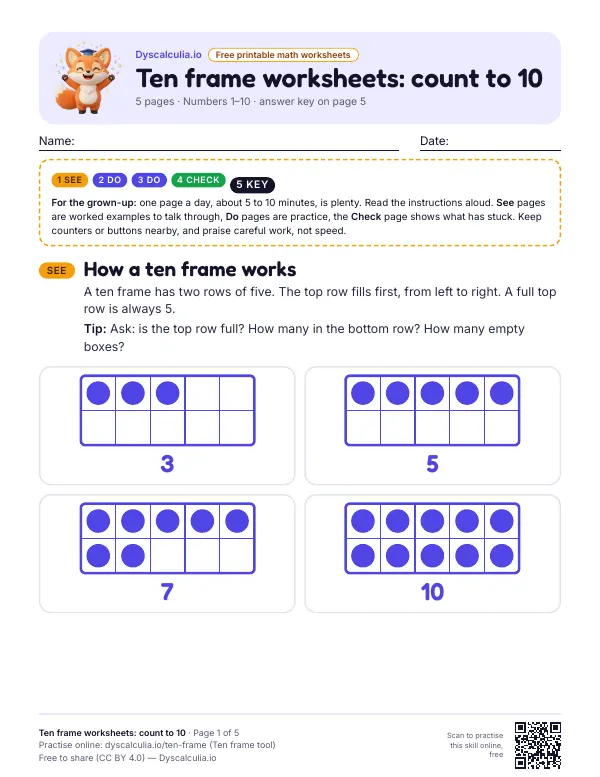
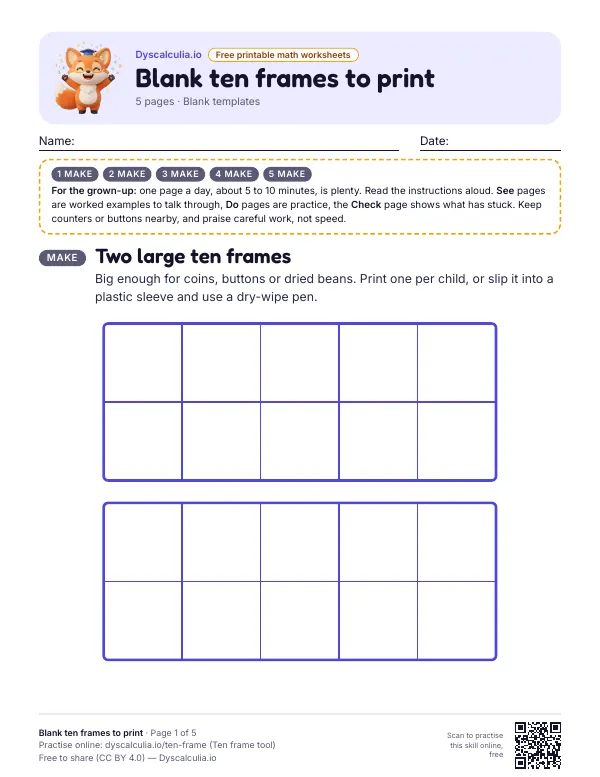
A ten frame is a rectangle split into two rows of five boxes, used in early maths to show numbers from 0 to 10 with counters. Counters fill the top row from left to right, then the bottom row, so 7 always looks like a full row of five and two more, and the empty boxes show how many more make 10. Two ten frames side by side (a double ten frame) show numbers to 20 as one full ten and some ones. Dyscalculia.io's free interactive ten frame lets children build numbers, see how many more make 10, practise with flash cards and print blank frames.
1–9
for any number from 1 to 9, finding the number that makes 10 is a kindergarten standard: the empty boxes show it1
Up to 4
dots most people see at a glance without counting: the rows of five let children combine small groups instead2
Strong
evidence level the What Works Clearinghouse gives representations such as 10 frames and double 10 frames in maths intervention3
- A ten frame has 10 boxes in 2 rows of 5.
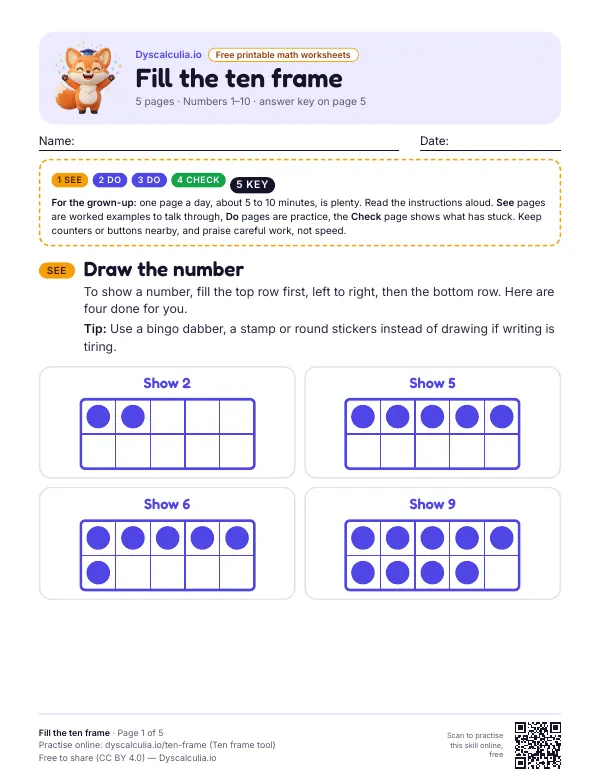
- Counters fill the top row left to right first, then the bottom row.
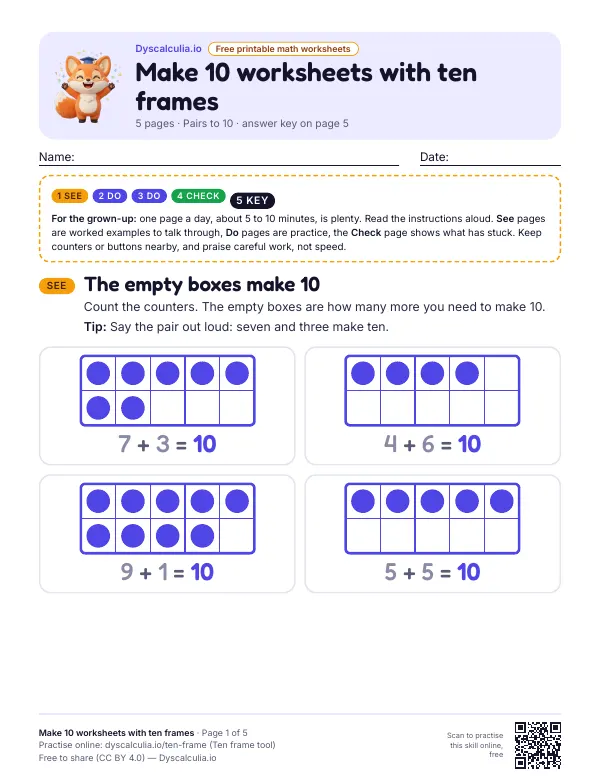
- Empty boxes show the number that makes 10: 7 counters leave 3 empty.
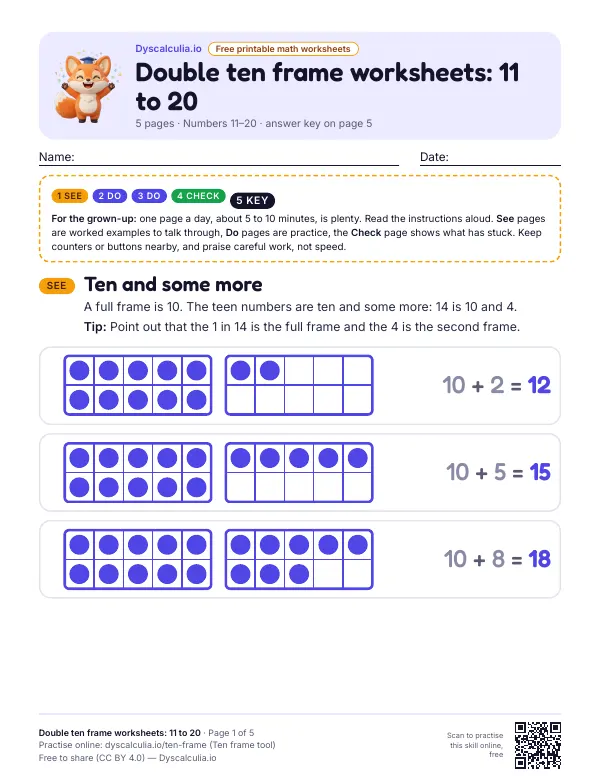
- A double ten frame shows 11 to 20 as ten and some more: 14 = 10 + 4.
- Free, no sign-up, works on phones and interactive whiteboards.
How to use a ten frame
Use real counters, the printable frames or the interactive frame above. Five minutes is enough; stop while it is still fun.
- 1
Fill the top row first
Place counters in the top row from left to right, then start the bottom row on the left. The same order every time is what makes numbers recognisable.
- 2
Say how many without counting
Ask 'How many?' and look for answers like 'five and two, so seven' rather than counting each counter.
- 3
Say how many more make ten
Point to the empty boxes: 'Seven counters, three empty, so 7 and 3 make 10.' This is the start of number bonds to 10.
- 4
Use two colours to add
Put 4 red and 3 yellow counters in the frame and write 4 + 3 = 7. Swap the colours to show 3 + 4 = 7.
- 5
Move to the double ten frame
For 11 to 20, fill one frame completely and put the rest in the second: 14 is one full ten and 4 ones.
How a ten frame is laid out and why it is filled in order
A ten frame has two rows of five boxes. The row of five matters as much as the ten: children can see small groups of up to about four at a glance, and a full row of five plus a few more is easier to take in than seven scattered dots. Filling the top row first, left to right, means 6, 7, 8 and 9 always look like five and some more, and the number of empty boxes is always the distance to ten.
That layout matches two of the first things US standards ask of kindergarten: splitting numbers up to 10 into pairs in more than one way, and finding the number that makes 10 with any number from 1 to 9. The double ten frame carries the idea into first grade, where the numbers 11 to 19 are understood as a ten and some ones.2,1,4
Ten frame examples from 1 to 20
The table shows what a filled frame looks like for some numbers and how a child can say it. Build any of them in the interactive ten frame above.
| Number | What the frame shows | How a child can say it |
|---|---|---|
| 3 | 3 in the top row, 7 boxes empty | 3, and 7 more make 10 |
| 5 | Top row full, bottom row empty | One full row of five |
| 7 | Top row full, 2 in the bottom row | 5 and 2 more; 3 more make 10 |
| 9 | One box empty | 1 less than 10 |
| 10 | Every box full | A full ten |
| 14 | First frame full, 4 in the second | 10 and 4 |
| 18 | First frame full, second frame with 2 empty | 10 and 8; 2 more make 20 |
Ten frame activities for kindergarten and first grade
Each of these takes a few minutes and works with the printable frames, real counters or the tool above.5
- Flash and say: show a frame for one or two seconds, hide it, ask how many. Switch the tool to Flash cards to do this on screen.
- Make ten: show a number and ask how many more make 10. Write it as 6 + 4 = 10.
- Two-colour addition: red counters for the first number, yellow for the second, then write the sum.
- Take away: start with a full frame, remove some, say what is left: 10 − 3 = 7.
- Make ten to add: for 8 + 5, move 2 of the 5 into the first frame to make 10, then 10 + 3 = 13 (the 'making ten' strategy from first grade).
- Teen numbers: build 11 to 19 on a double ten frame and read them as ten and some ones.
Common ten frame mistakes
The frame only helps if the picture stays consistent. These habits undo that.
- Filling boxes in a random order: 7 then looks different every time, and children go back to counting one by one.
- Starting the second row before the first is full: the 'five and some more' pattern disappears.
- Counting every counter: if a child always counts from 1, slow down and use flash mode with numbers up to 5 first.
- Skipping the empty boxes: the gaps carry half the meaning. Always ask how many more make 10.
- Moving to the double ten frame too early: children should know the single frame to 10 first.
How a ten frame helps children who find numbers hard
The What Works Clearinghouse practice guide for students who struggle with mathematics rates the use of concrete and semi-concrete representations as supported by strong evidence, and it lists 5 frames, 10 frames and double 10 frames among the semi-concrete representations for addition and subtraction. The usual path is real counters, then a drawn or on-screen frame, then numbers alone.
Children with dyscalculia are slower on basic number tasks such as counting dots, and in one dot-counting study they needed more extra time for each added dot than their peers even within the range most people see at a glance. A ten frame does not replace practice of those skills, but it gives a stable picture of 5 and 10 to anchor them. Subitizing practice works on the at-a-glance part directly.
If counting by ones persists, the free dyscalculia test checks dot recognition and four other number skills in about ten minutes. Number bonds are the natural next step after the ten frame, and the place value chart carries tens and ones into bigger numbers.3,6,2