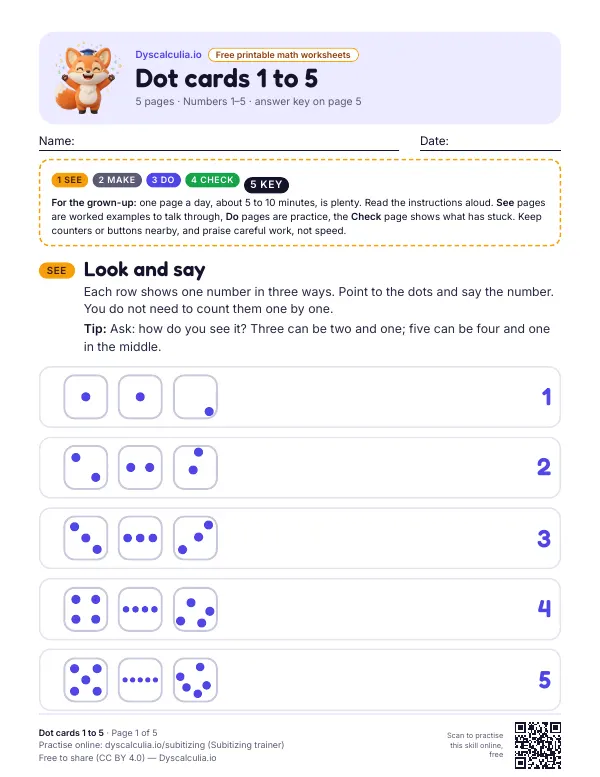
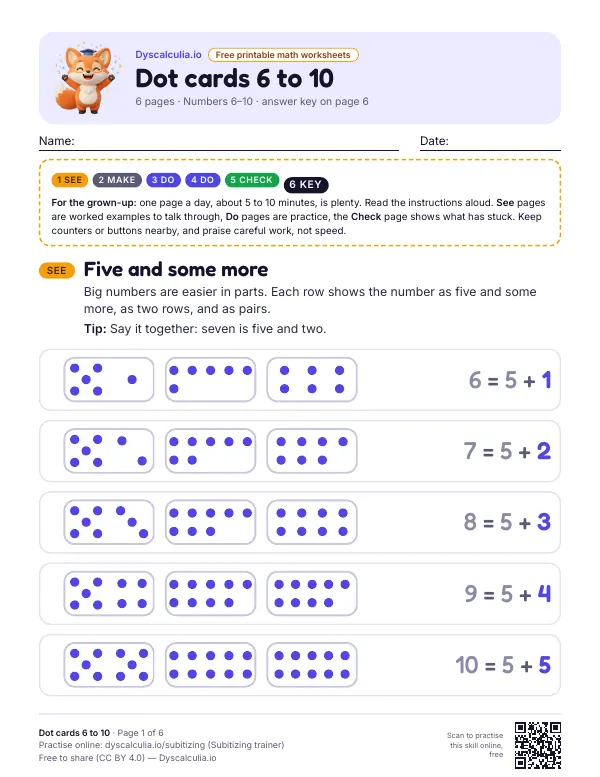
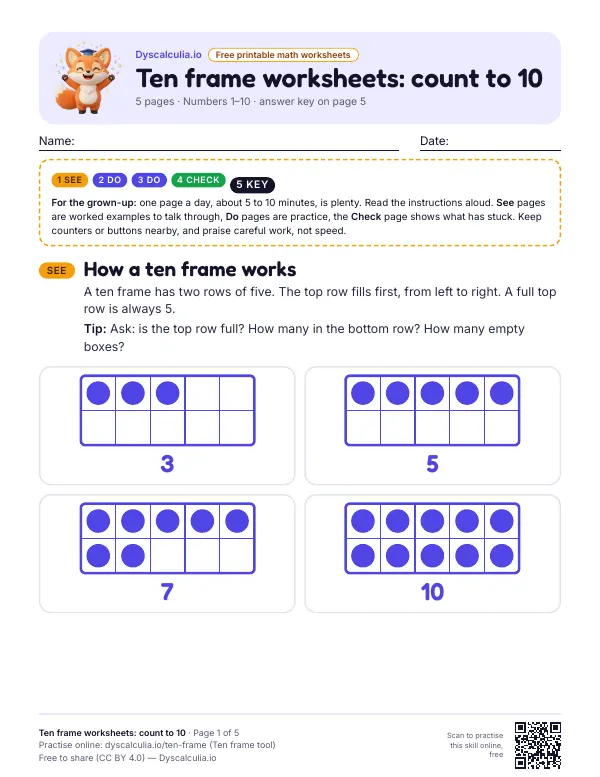
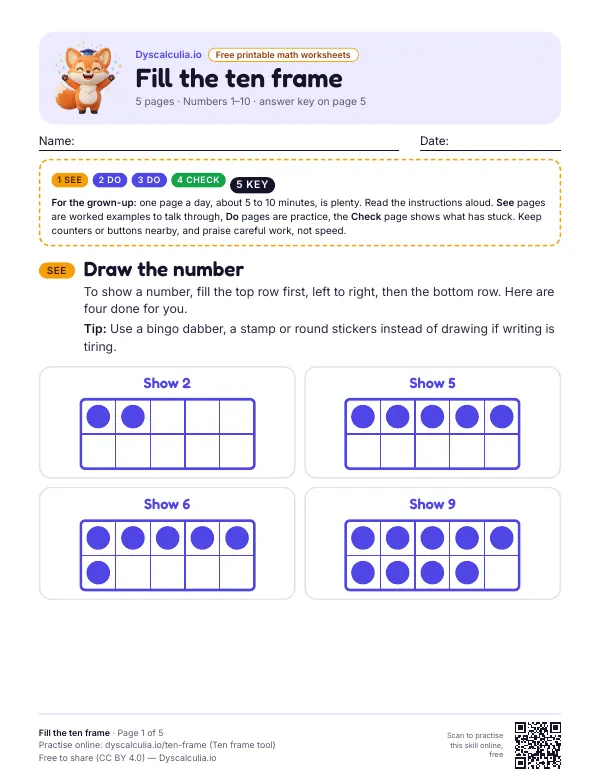
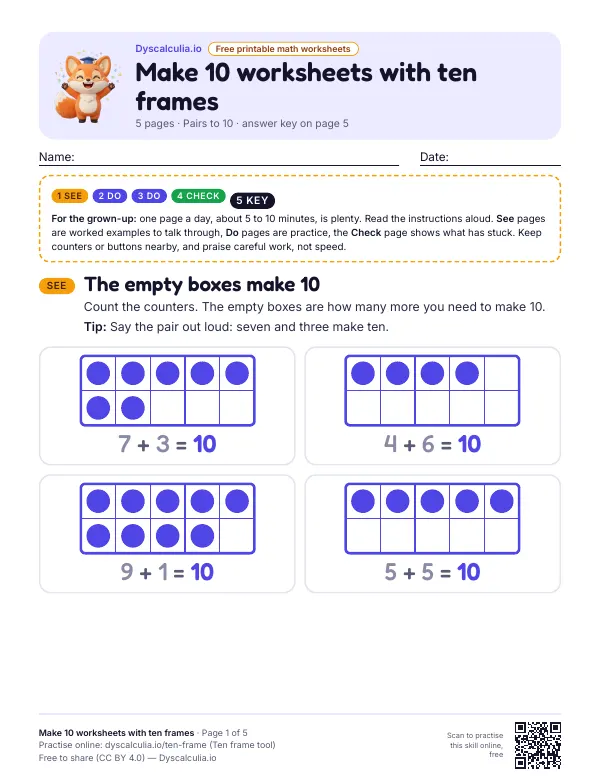
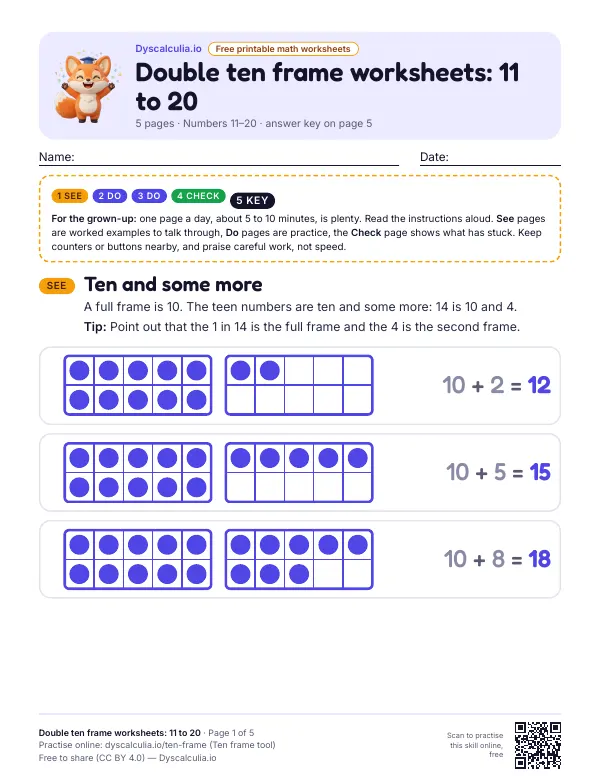
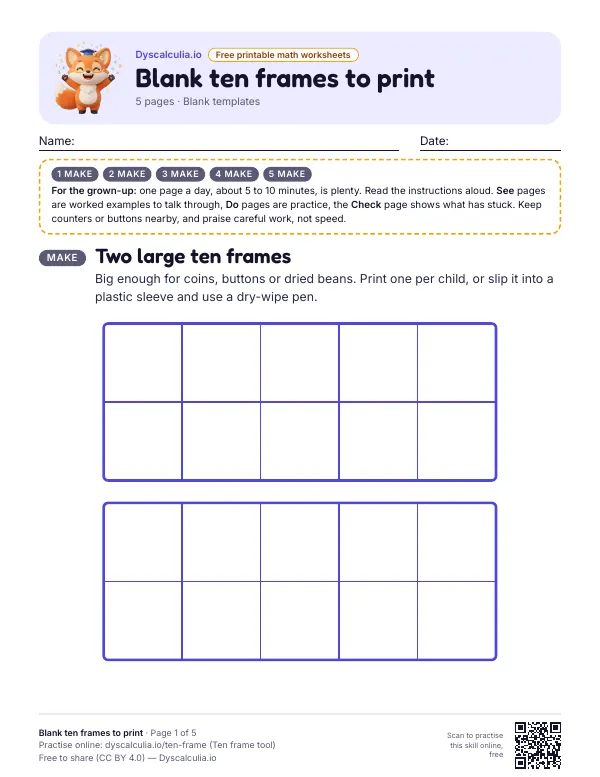
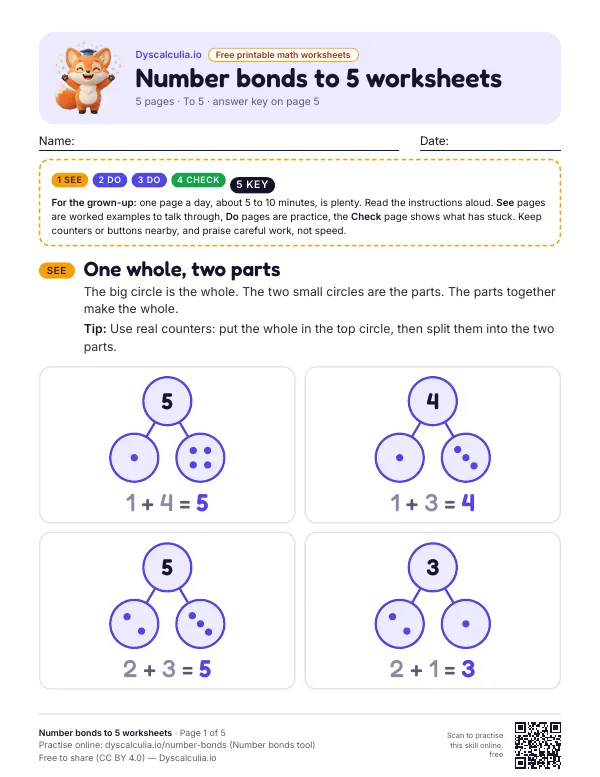
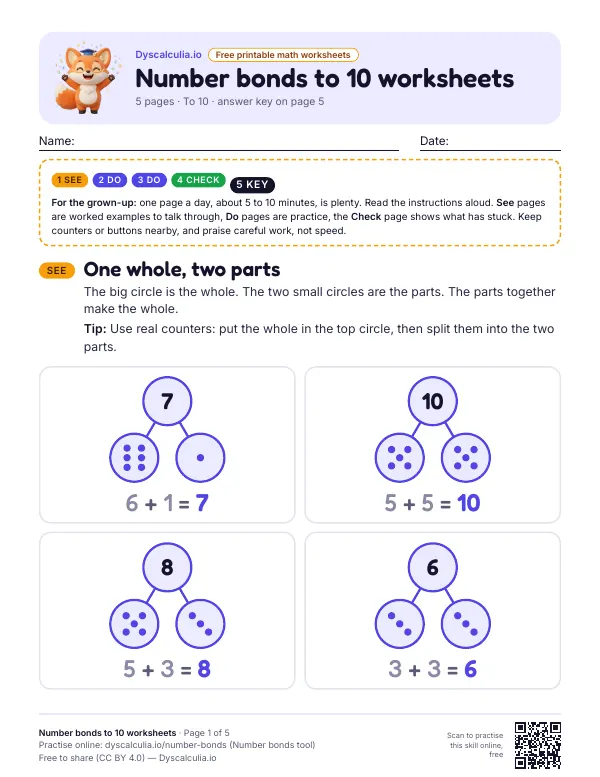
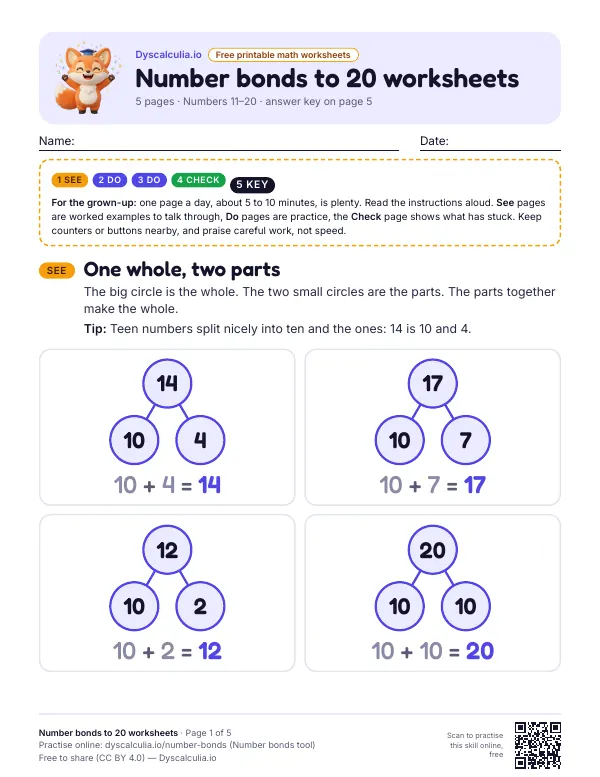
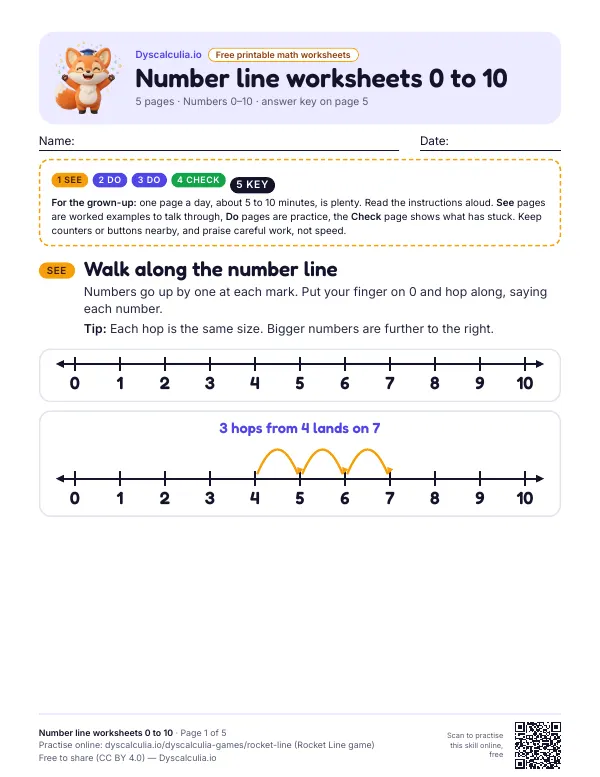
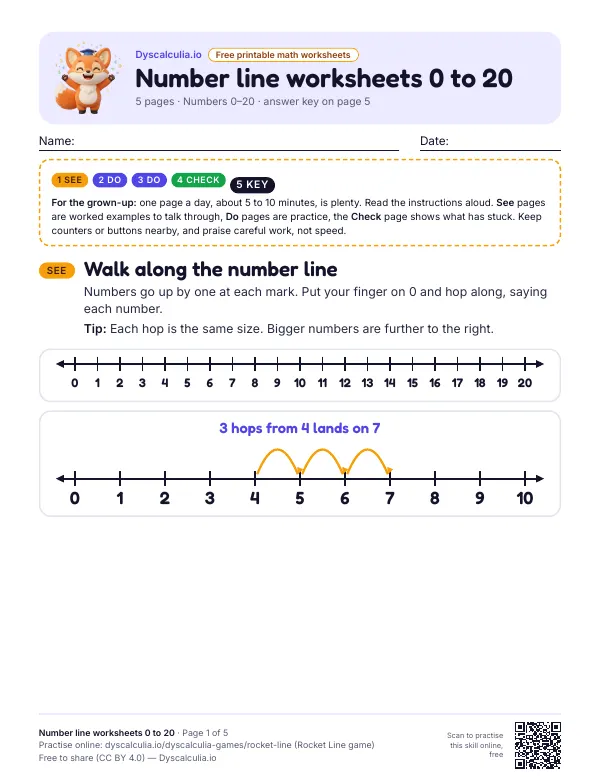
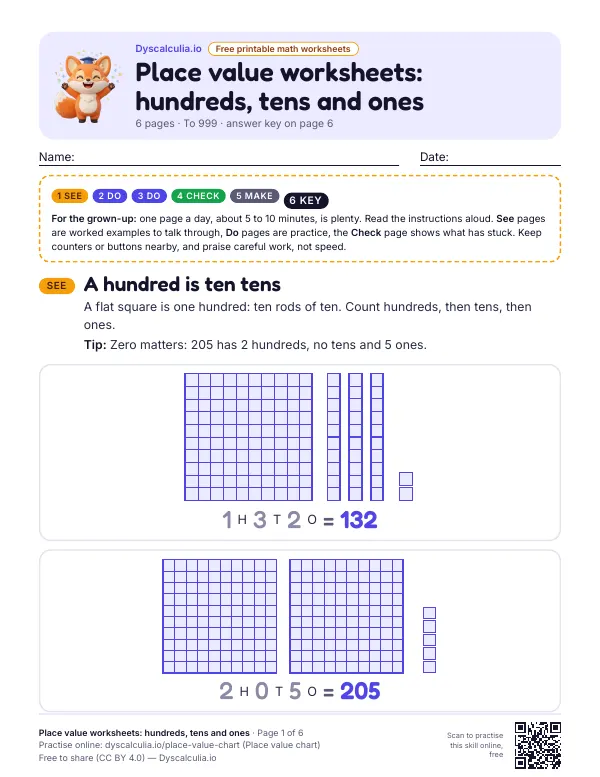
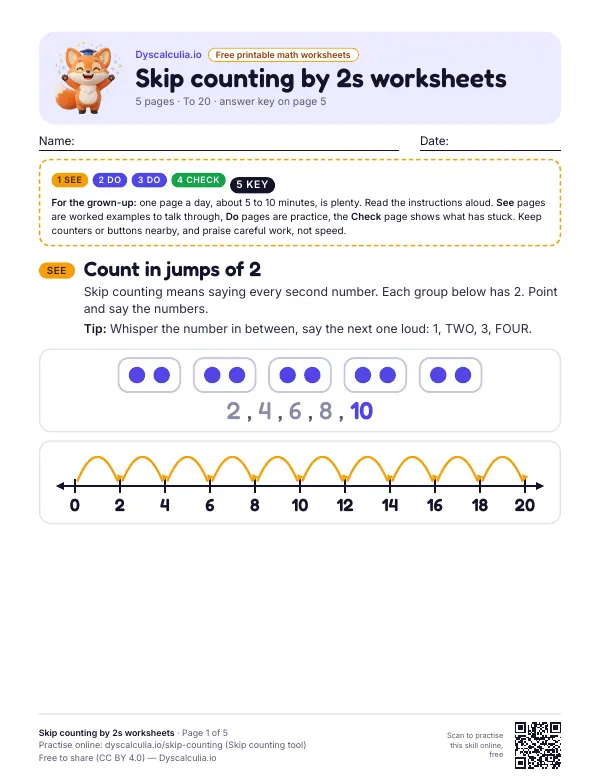
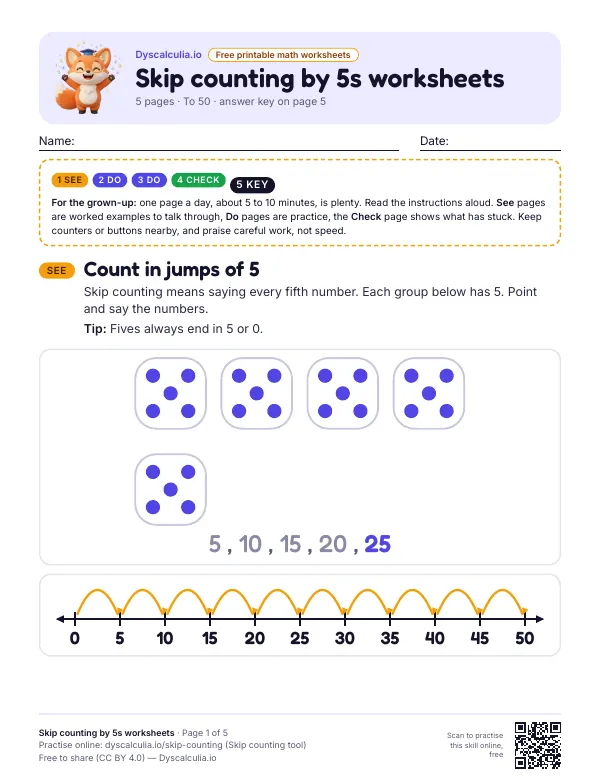
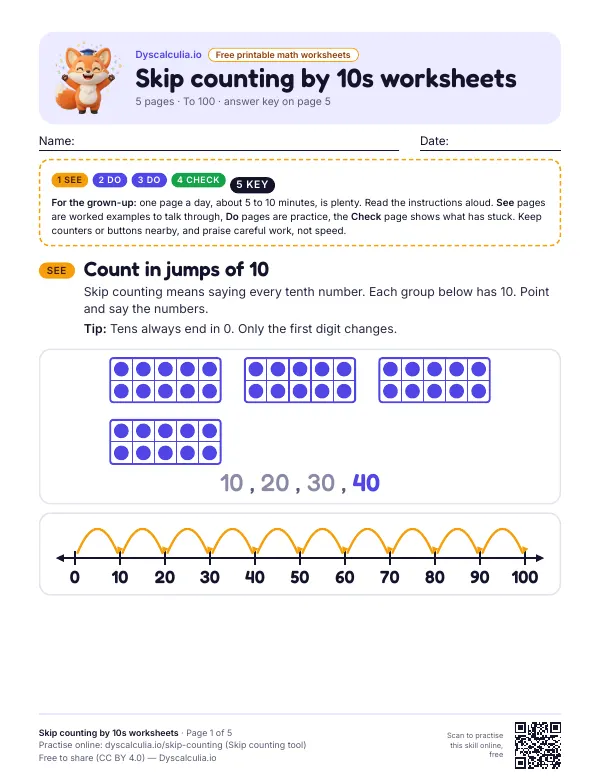
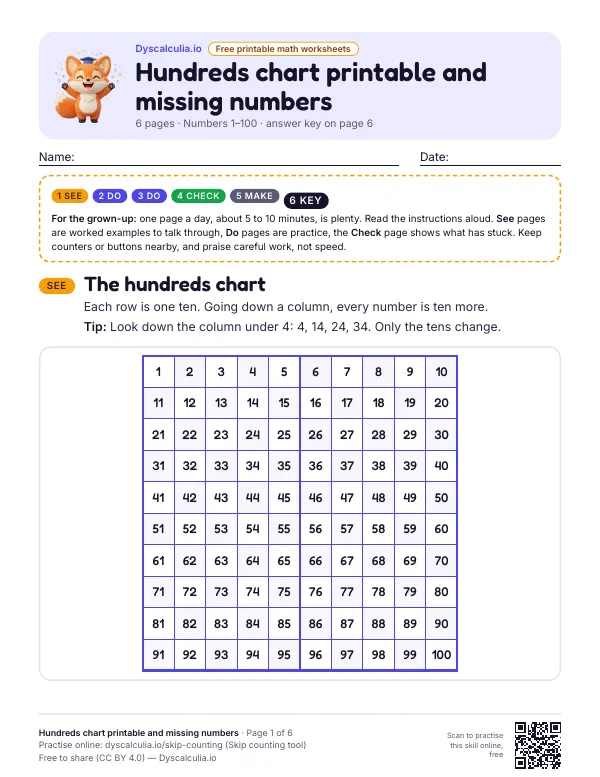
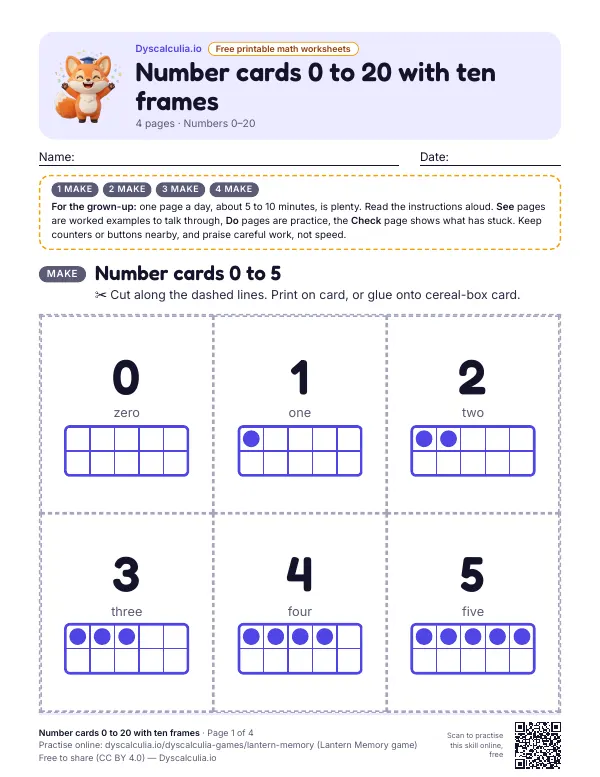
What is in each worksheet pack: see, do, check
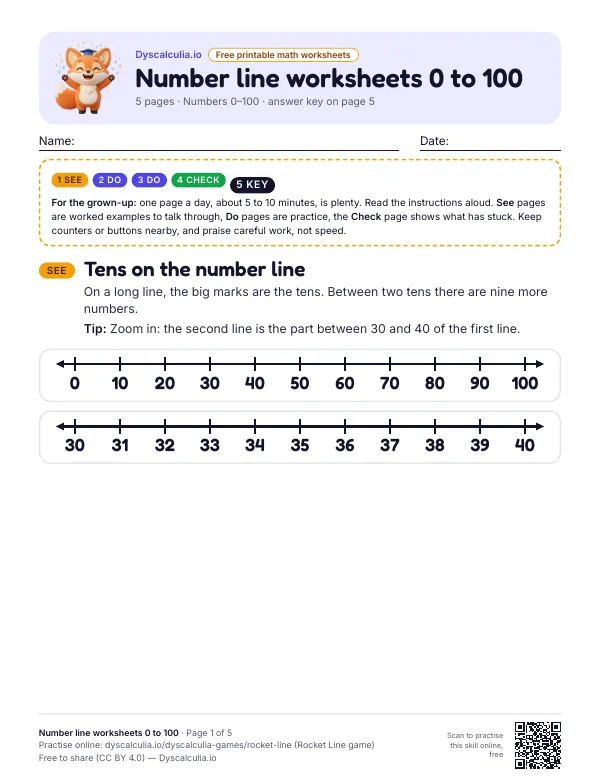
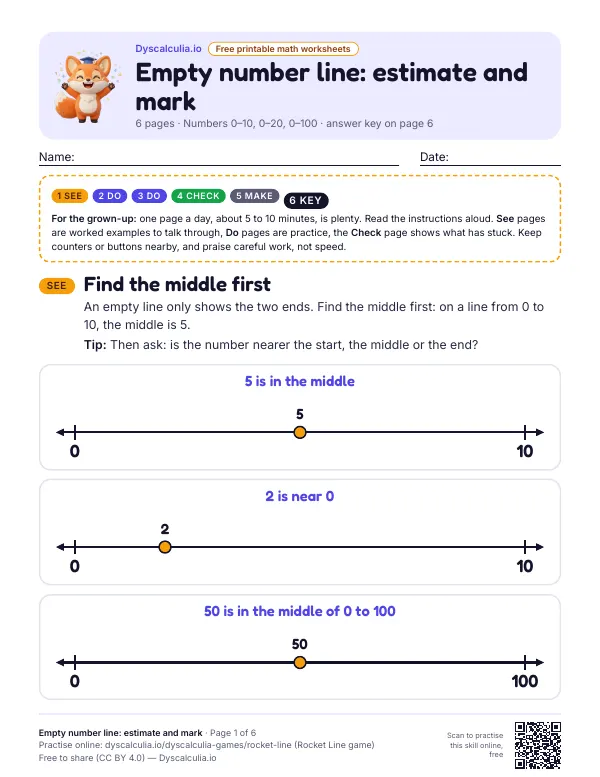
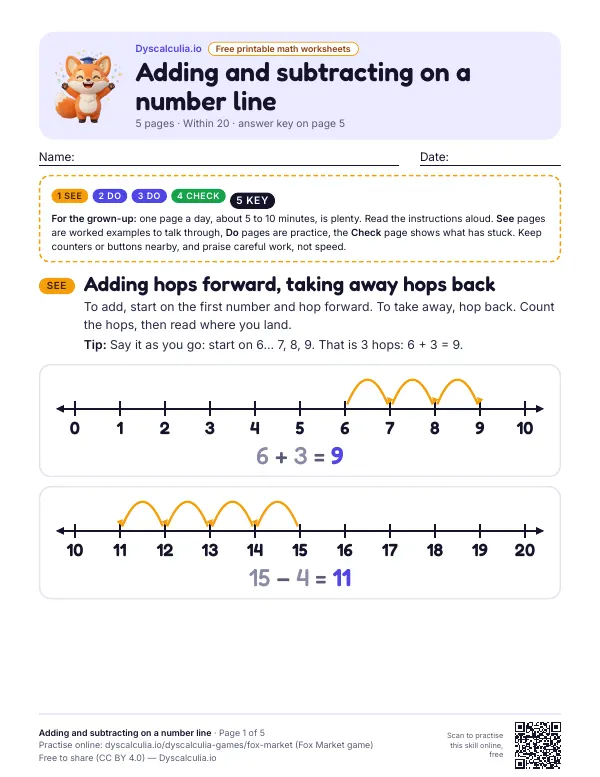
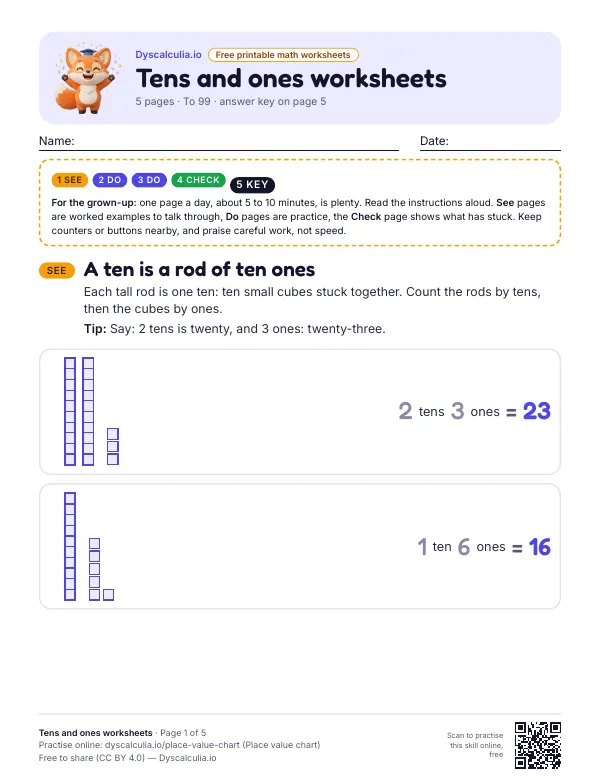
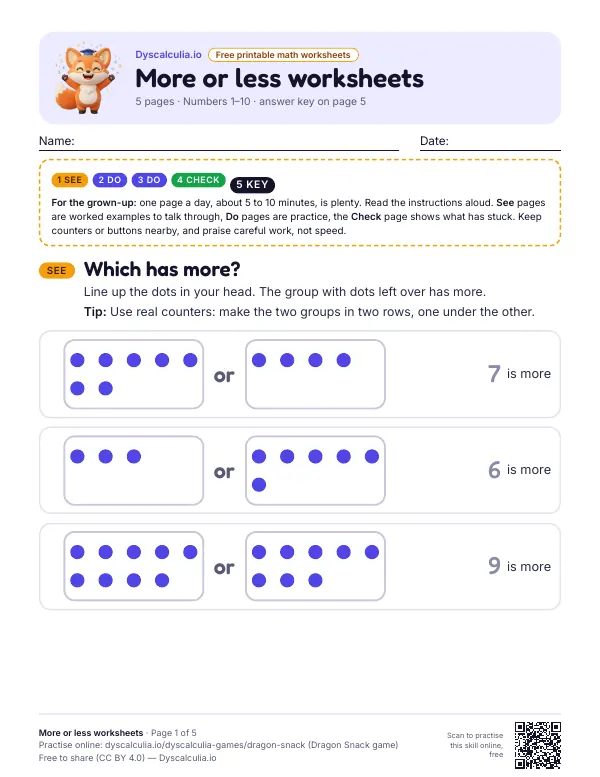
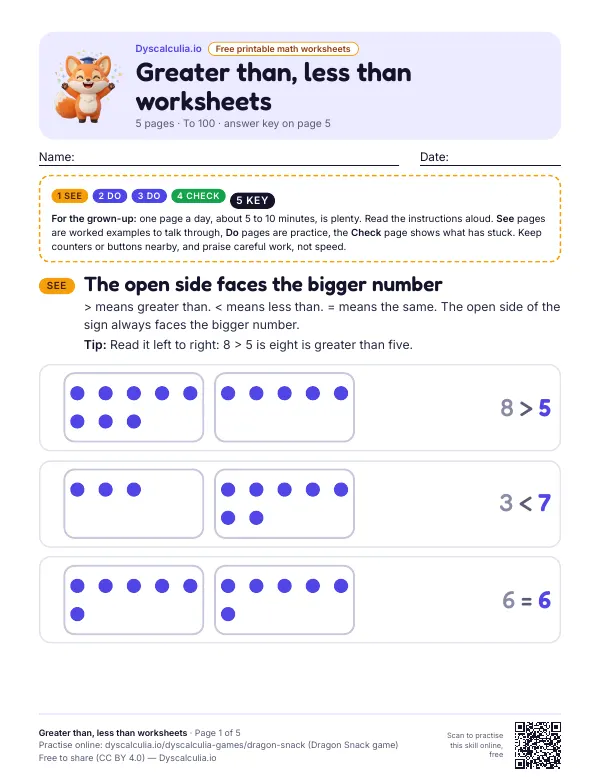
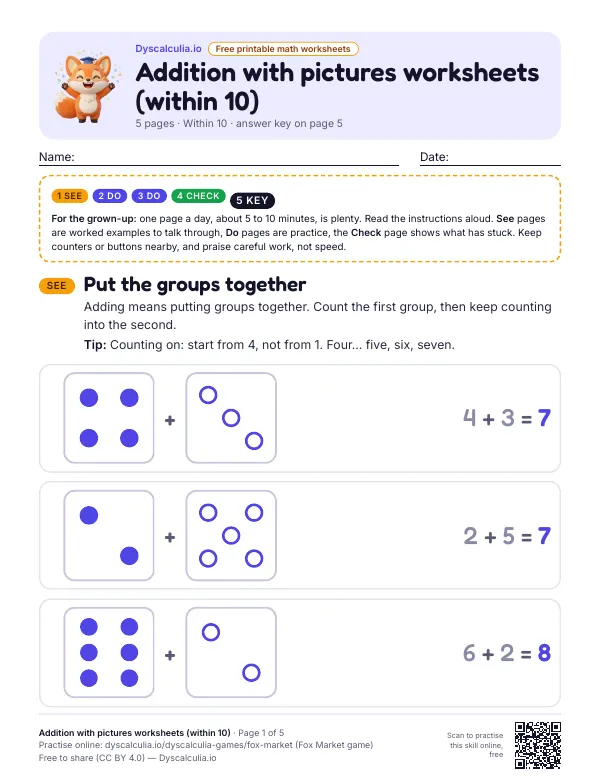
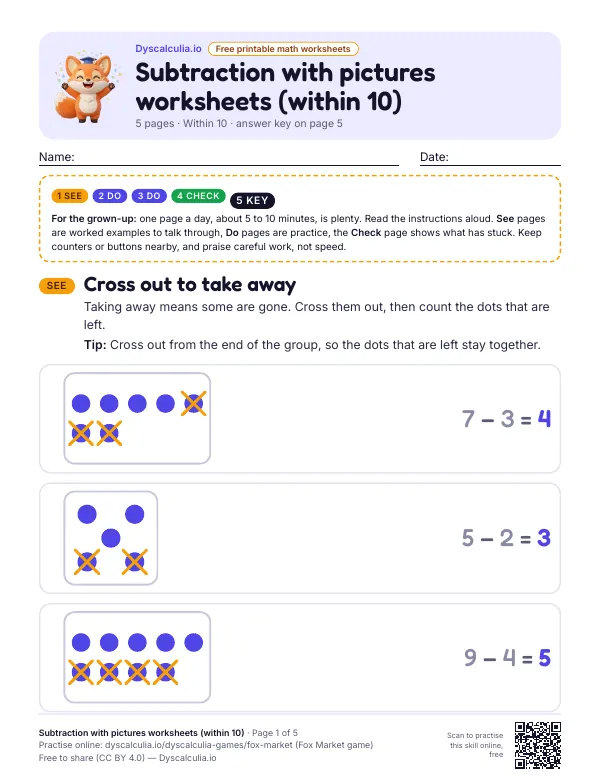
Most packs have five or six US Letter pages in the same order, so once your child knows the routine, all their effort goes into the maths. The first page is a See page: worked examples with the answers already filled in, to talk through together. Two Do pages follow with the actual practice, each a small step on from the last. The Check page uses the same skill with fewer pictures, or none, and ends with an "I can" sentence and three stars to colour. The last page is the answer key, for the grown-up.
The template packs (blank ten frames, blank number lines, a blank hundreds chart and a blank place value chart) and the number cards have no right or wrong answers, so they come with game ideas instead of a key. Every page carries a QR code and a short link to the matching free tool or game on this site, so a child can move from the paper to the screen and back.
- Step 1Seeworked examples
- Step 2Dopractice
- Step 3Checkcheck
- Step 4Keyanswers
Why the worksheets start with dots and pictures
Dyscalculia is a lasting difficulty with number sense: knowing how many things there are, which of two amounts is bigger, and where a number sits among the others. A child can learn to say "seven" and write 7 without feeling how much seven is. Worksheets that jump straight to columns of sums train the symbols and skip the quantity, which is exactly the part that is missing.
So each pack follows the order teachers call concrete, pictorial, abstract. Concrete means real objects: keep counters, buttons or dried beans next to the sheet. Pictorial means the dots, ten frames, number lines and blocks printed on the page. Abstract means numbers on their own, which only come on the Check page. Amounts from 6 to 10 are always drawn in a structure, as five and some more, two rows or pairs, because a random scatter of eight dots cannot be seen at a glance by anyone and only invites counting one by one.
Ten frames, number bonds and the empty number line get a lot of space because they make the parts of a number visible: 8 is a full row of five and three more, 8 is 5 and 3, 8 is two hops short of 10. Children who can see those parts start to calculate instead of counting on their fingers.
How to use the worksheets at home
One page a day is enough: about five to ten minutes, at a calm time, with you sitting next to your child. Read the instruction aloud, do the first item together, then let your child work. Say the numbers out loud as you go, and point at the dots rather than at the digits. A worksheet that ends in success is worth more than one that is finished. For hands-on practice away from paper, use the dyscalculia exercises with dice, cards and a number line.
When an answer is wrong, do not just correct it. Go back to the picture: count the dots, fill the ten frame with counters, hop along the number line with a finger. Mistakes are information. If the same kind of mistake comes up twice, repeat the Do page the next day with real objects. Move on to the next pack when the Check page has gone well on two different days.
Mix paper with screens. The free ten frame tool, number bonds tool and subitizing trainer practise the same skills, and the QR code on each page leads straight to the right one.
Using the worksheets at school, in tutoring and in small groups
The packs are licensed CC BY 4.0: you can print them for a whole class, put them in a shared drive, or copy them into an intervention folder, as long as the Dyscalculia.io credit on each page stays. Because every pack has the same see, do, check order, they work well for small-group intervention and for teaching assistants: the See page is the mini-lesson, the Do pages are the practice and the Check page is a quick progress note.
The numbers are generated from a fixed seed, so every copy of a pack is identical: the answer key always matches, and two children on the same pack can compare answers. For practice beyond the paper, the free place value chart and skip counting tool can be projected on a whiteboard.
Which worksheet pack to start with
Start one step below where your child gets stuck. A common order is: dot cards 1 to 5, counting the ten frame, filling the ten frame, number bonds to 5, dot cards 6 to 10, make 10, number bonds to 10, the number line to 10 and to 20, more or less, adding and taking away with pictures, double ten frames and number bonds to 20, then tens and ones, skip counting, greater than and less than, the hundreds chart, the number line to 100 and hundreds, tens and ones. Go by what your child can do, not by their age or grade.
If you are not sure which number skills are the weak ones, the free dyscalculia test takes under 5 minutes, needs no account, and shows a profile of five number skills. It is a screening, not a diagnosis.
Worksheets, free games and the Dyscalculia.io program
The worksheets and the six free online dyscalculia games practise the same skills: Berry Count goes with the dot cards, Muffin Ten with the ten frames, Rocket Line with the number lines, Dragon Snack with comparing and Fox Market with adding and taking away. Nothing is saved and nothing needs an account.
The paid Dyscalculia.io program builds a 5 to 10 minute plan each day from the results of the free test, brings back the items a child got wrong after one, three, seven and thirty days, and makes each block easier or harder depending on how the last one went. With a free account level 1 of every game in each age world is open (24 of the 196 levels); the full program costs $9.99 a month or $39.99 a year. The worksheets stay free either way.
Not sure where to start? Take the free dyscalculia test — five short games, under 5 minutes, no account.