
Short answer
What is subitizing?
Subitizing is the ability to see how many objects are in a small group instantly, without counting. Perceptual subitizing is recognising up to about four or five items at a glance; conceptual subitizing is seeing a larger amount as known parts, such as eight on two dice as four and four. The term was coined in 1949 by Kaufman and colleagues from the Latin subitus, meaning sudden. Subitizing is an early building block of number sense, and children with dyscalculia often subitize less efficiently. Dyscalculia.io's free dot-flash trainer lets children practise with dice, ten-frame and finger patterns.
1–3 → 1–5
how the subitizing range grows between ages 2 and 51
Age 6
dot-enumeration speed at 6 predicted arithmetic at 9½ and 102
Steeper
subitizing slopes in children with dyscalculia than in classmates3
- Subitizing means knowing how many without counting.
- Perceptual subitizing covers about 1–4 or 1–5 items.
- Conceptual subitizing sees larger amounts as parts (5 and 3 make 8).
- Between ages 2 and 5 the subitizing range grows from about 1–3 to about 1–5.
- Children with dyscalculia often show a less efficient subitizing pattern.
How to practise subitizing with the dot-flash trainer
Five minutes is enough. The goal is fast, confident recognition and talking about how the amount was seen, not a high score.
- 1
Start with dice and 1 to 5
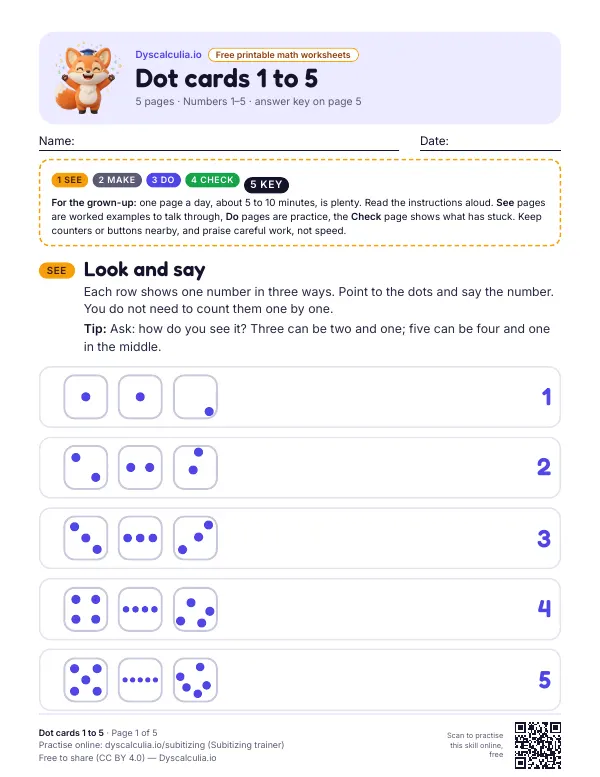
Choose the Dice pattern and the range 1 to 5. Dice faces are the easiest layouts to recognise, so early answers are usually right.
- 2
Pick a flash time
Begin with 1.5 or 2 seconds. When most answers are right, shorten it to 1 second so there is no time to count one by one.
- 3
Ask how they saw it
After each card, ask: how did you know? Answers like "three and two" or "a full row and one more" show conceptual subitizing growing.
- 4
Move to ten-frames and fingers
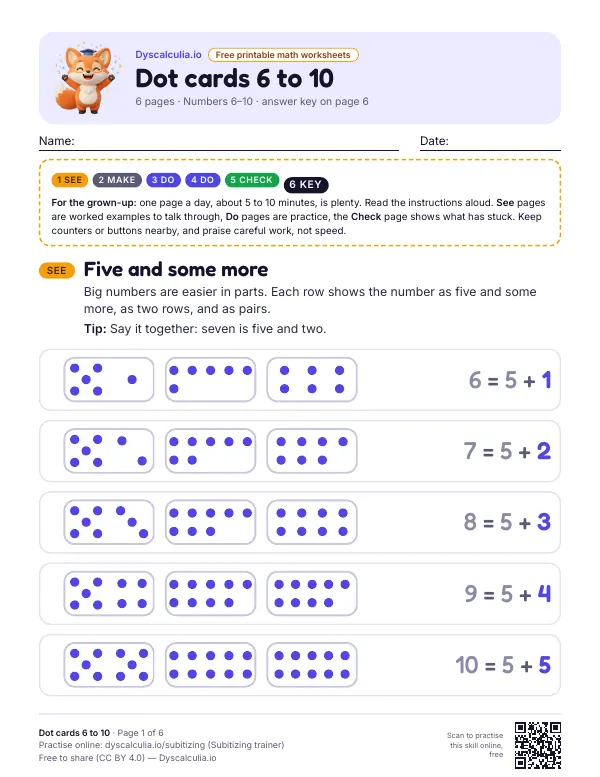
Switch to Ten-frame or Fingers and the range 1 to 10. Both use five as an anchor, so six becomes "five and one" rather than six separate dots.
- 5
Try random and mixed
Random layouts are harder because there is no pattern to lean on. Use them once structured patterns feel easy, and keep the numbers small.
- 6
Print the dot cards
Print the cards for the pattern you are using and play away from the screen: flash a card, hide it, and take turns.
What is subitizing? Perceptual and conceptual subitizing
Subitizing is the instant "I just see it" sense of how many. Show a child three dots for a moment and they can say "three" without pointing at each dot. The word comes from a 1949 study by Kaufman, Lord, Reese and Volkmann, who measured how quickly adults judged the number of dots flashed on a screen and named the fast, accurate range for small numbers after the Latin subitus, meaning sudden.
Mathematics educator Douglas Clements separated two kinds. Perceptual subitizing is the direct kind: recognising one to about four or five things with no other mental work. Conceptual subitizing builds on it: seeing eight dots on two dice as "four and four", or seven fingers as "a whole hand and two". Conceptual subitizing is already a little piece of addition, which is why it is worth practising with patterns rather than only with scattered dots.4,5
- Perceptual subitizing: 1 to about 4–5 items, recognised directly.
- Conceptual subitizing: larger amounts seen as known parts (5 + 3, 4 + 4).
- Counting: one by one, with a number word for each item — slower and needed for larger sets.
Why subitizing matters for number sense
Subitizing links a number word to an amount you can see. A child who sees four dots as "four" without counting has connected the word, the quantity and, later, the digit. Clements argued that subitizing should be taught deliberately in early maths for exactly this reason: it is how small numbers start to feel like real amounts rather than a sequence of words.
It also matters later. In a study that followed 159 children for six years, Reeve, Butterworth and colleagues found that children's speed and pattern when naming small sets of dots at age 6 predicted their arithmetic at age 9½ and 10. Children who could see small amounts quickly had a head start with calculation.5,2
- Number words get attached to real amounts.
- Seeing parts (3 and 2) prepares addition and subtraction.
- Five-and-ten structures prepare place value.
- Fast recognition frees attention for the actual problem.
Subitizing and dyscalculia: what the research shows
Researchers who study dyscalculia often use dot-naming tasks because they reveal how basic quantity processing works. Schleifer and Landerl compared children with dyscalculia and typically developing children: both groups showed a clear switch from fast subitizing to slower counting, but the children with dyscalculia had steeper subitizing slopes, meaning each extra dot cost them noticeably more time even in the small range.
Butterworth and colleagues describe dyscalculia as a core difficulty with representing and handling numerosities — exactly the sets of things that subitizing deals with. That is why the free dyscalculia test on this site includes a short dot game.
A child who is slow to subitize is not therefore dyscalculic. Some children simply have not practised, others are anxious or distracted. Practice like the trainer above is useful for any young learner; if number difficulties persist alongside other signs, see dyscalculia symptoms by age. A screening is not a diagnosis; only a qualified professional can make one.3,6
Subitizing by age: what to expect
Children vary a lot, so treat the table as a rough guide rather than a norm. In Starkey and Cooper's experiments with 2- to 5-year-olds, dots were shown for only a fifth of a second, too fast to count, and the range children could name accurately grew from about one to three to about one to five over those years. Conceptual subitizing of six to ten in structured patterns develops in the first school years with practice.1,5
| Age | Usually recognised at a glance | What to practise |
|---|---|---|
| 2–3 | 1 and 2, then 3 | Name small groups of toys and snacks |
| 4 | Up to about 4 | Dice faces, dot cards to 4, finger patterns to 5 |
| 5 | Up to about 5; starts to see 6–10 in dice or ten-frames | Ten-frames, two dice, "five and…" |
| 6–7 | Structured patterns to 10 as parts | Mixed and random layouts, saying the parts aloud |
Subitizing activities for kids at home and in class
Subitizing practice works best in short, playful bursts. Flash, hide, ask, and then talk about how the amount was seen. The trainer at the top of this page does the flashing; these activities take the same idea off the screen. For more ideas built around the same skills, see number sense activities and the dyscalculia exercises page.
- Dot-card flash: show a printed card for a second, then hide it. Ask how many and how they knew.
- Dice race: roll two dice and say the total without counting the pips one by one.
- Ten-frame quick look: fill a 2 × 5 frame with counters, cover it, and ask how many — and how many more make ten. The interactive ten frame does this on screen.
- Show me fingers: say a number and ask for it on fingers without counting up; then swap roles.
- Dominoes snap: match domino halves that show the same number in different layouts.
- Hide and peek: put up to five small toys under a cup, lift it for a moment and ask how many.
How to use the printable subitizing dot cards
The "Print dot cards" button prints ten cards, one to ten, in the pattern you have selected: dice, ten-frame, fingers or random. Cut them out and keep each pattern as its own set at first. The small number in the corner is for the adult; fold it under or cover it while you play.
Good next steps with the cards: put them in order without counting, find two cards that make ten — the idea behind number bonds — or lay a dice card next to a ten-frame card and ask whether they show the same number. Ten-frame cards connect naturally to place value, and finger cards to counting on.