Muffin Ten: a free ten frame game
The fox's muffin tray is a ten frame: two rows of five cups. Your child looks at the filled cups and taps how many muffins there are. Every finished tray goes into the shop window.
- Ten frames
- 2 levels
- Free · no sign-up
How to play Muffin Ten
- 1
Look at the tray
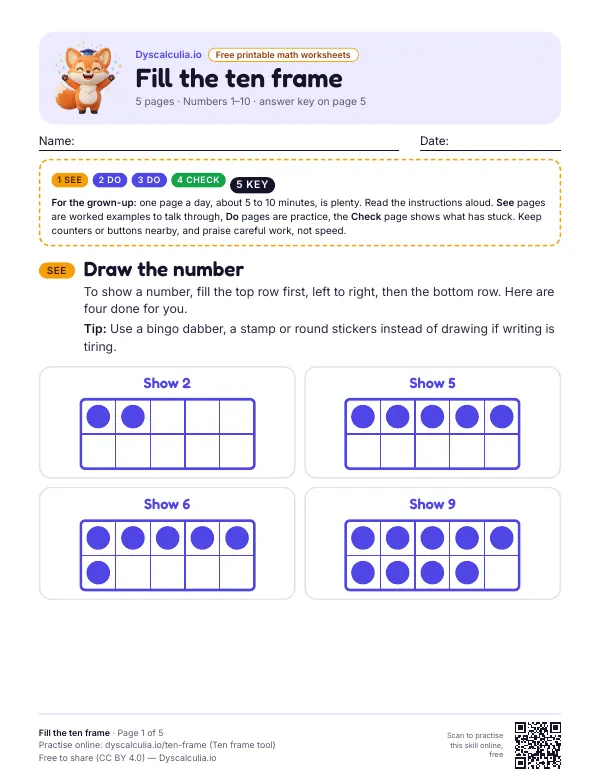
Muffins fill the cups row by row: first the top row of five, then the bottom row. A line between the rows shows the five.
- 2
Tap the number
Tap the cookie with the right number, or type it. Level 1 uses 1 to 5 muffins, level 2 uses up to 10.
- 3
See it explained
Right: the fox puts a cherry on each muffin while counting. Wrong: the muffins are numbered one by one and the tray shows, for example, 5 and 3 more = 8.
What Muffin Ten practices: seeing numbers as five and ten
A ten frame is two rows of five boxes. It helps children see a number as a structure instead of a pile: 8 is a full row of five and 3 more, or 2 less than 10. That structure is what children later use for adding, making 10 and number bonds, and it is a step many children with dyscalculia miss.
Muffin Ten fills the tray in the same order every time, top row first, so a child can learn to read the amount from the shape. Level 1 uses 1 to 5 muffins in the top row; level 2 uses 1 to 10. The rules are the same as the ten-frame exercise in the Dyscalculia.io program.
A wrong answer never ends the round: the muffins are counted out with the five highlighted, the right cookie glows and the child taps it. Only first tries count towards the stars.
Not sure which skill to start with? Take the free dyscalculia test — five short games, under 5 minutes, and a profile of five number skills.
All 2 levels of Muffin Ten
Pick a level under the game. The levels are the same steps as in the Dyscalculia.io program, from easy to hard; each round makes 10 new questions.
| Level | What your child practices |
|---|---|
| 1 | 1 to 5 muffins in the top row, answer 1–5 |
| 2 | 1 to 10 muffins, both rows of five, answer 1–10 |
Common mistakes in Muffin Ten and what they tell you
Counting all the muffins from 1
A child who counts every muffin has not yet started to use the five. Point to the full top row and say “five”, then count on: six, seven, eight.
Mixing up 9 and 10, or 4 and 5
Near-full and near-empty trays look alike. Ask about the empty cups: one empty cup means 9, a full tray means 10.
Right answers, but slowly
Speed comes when a child reads the tray as a shape. Short, regular rounds help more than long sessions.
Tips for parents: getting the most out of Muffin Ten
- Ask “how many empty cups?” as well. Knowing that 7 needs 3 more to make 10 is the next step.
- Encourage your child to read the top row as “five” without counting it, then count on from 5.
- Draw a ten frame on paper or use an egg box with ten holes, and play the same game with buttons or pasta.
- Stay on level 1 until amounts up to 5 are seen at a glance, then move to level 2.
Printable ten frame worksheets
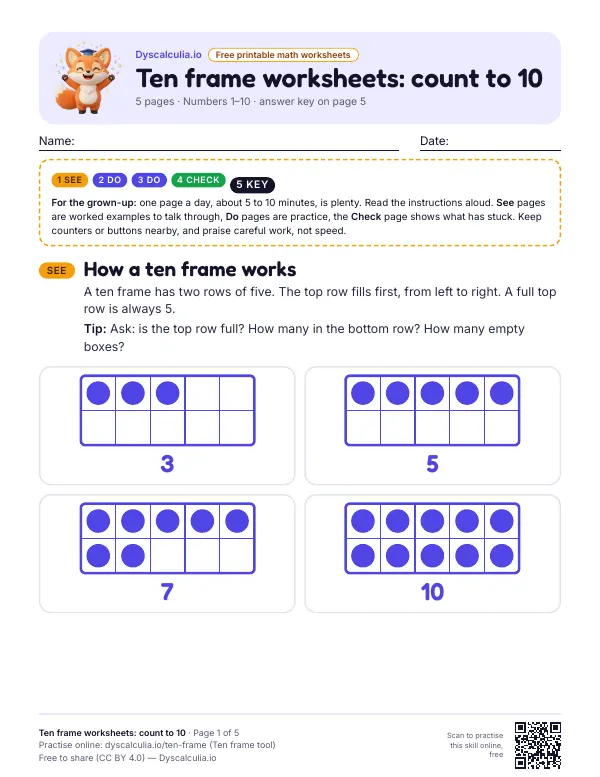
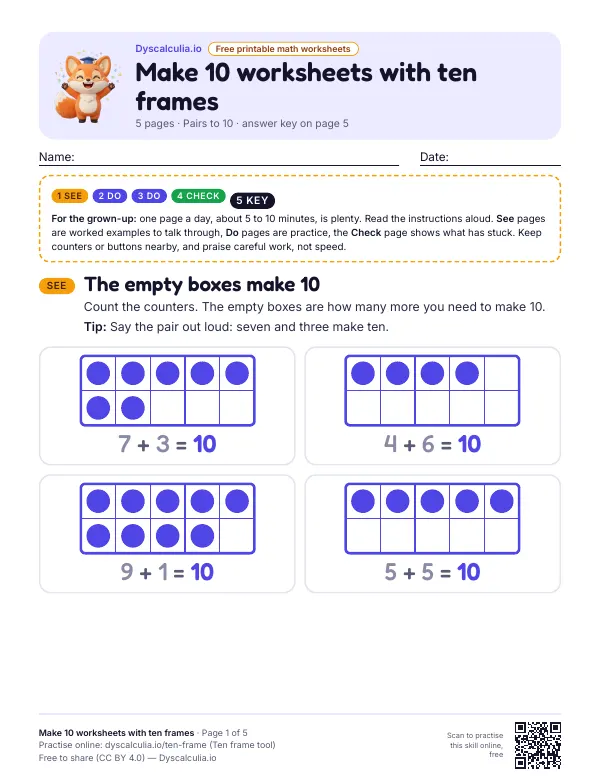
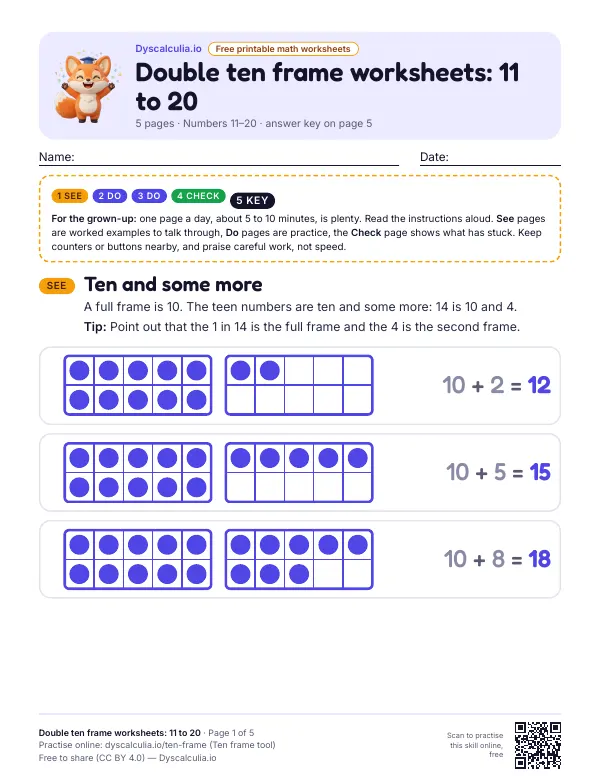
Take Muffin Ten off the screen: the same skill as free PDF worksheets, from dots and pictures to numbers, with an answer key on the last page.
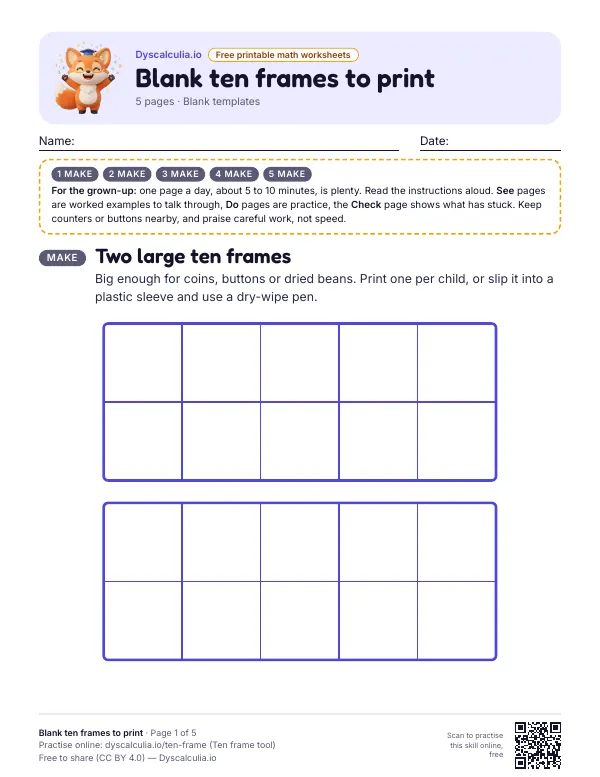
All 26 free dyscalculia worksheets → · Free to share (CC BY 4.0) — Dyscalculia.io
More free dyscalculia games
Muffin Ten: questions parents ask
Is Muffin Ten free?
Yes. Muffin Ten is free to play in the browser, with no account, no download and no ads. The paid part is the Dyscalculia.io program, which adds a daily plan, spaced review and saved progress.
What is a ten frame?
A ten frame is a grid of two rows of five boxes, used to show numbers up to 10. Filled boxes show the number, empty boxes show how many more are needed to make 10.
Does Muffin Ten work on a tablet or phone?
Yes. It runs in any modern browser and works with a finger, a mouse or the keyboard. On a phone, turn it sideways for the biggest picture.
Why does the game only have two levels?
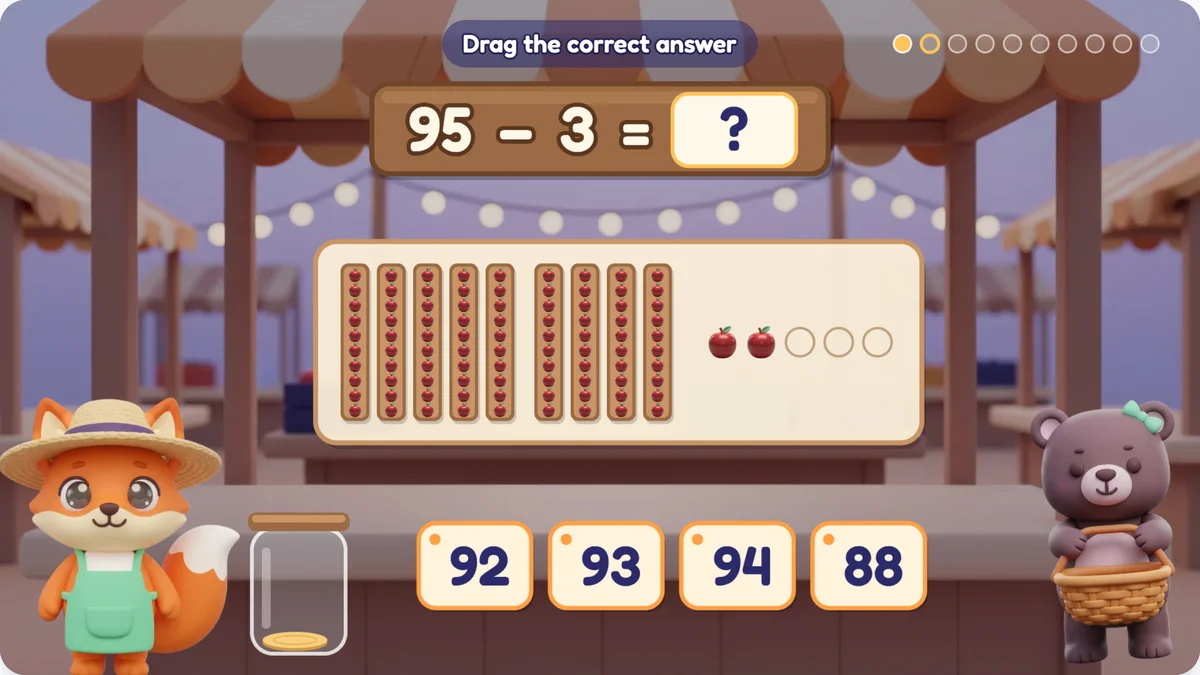
The ten frame exercise in our program has one rule for numbers up to 5 and one for numbers up to 10, so the game has the same two levels. For bigger numbers, try Fox Market.
How do ten frames help with making 10?
A ten frame shows at a glance how many more are needed to make 10: the empty cups. Once a child sees that 7 leaves 3 empty cups, facts like 7 + 3 = 10 and 10 − 7 = 3 come from the picture instead of from memory, which is far easier for children with dyscalculia.