
Short answer
What are number bonds?
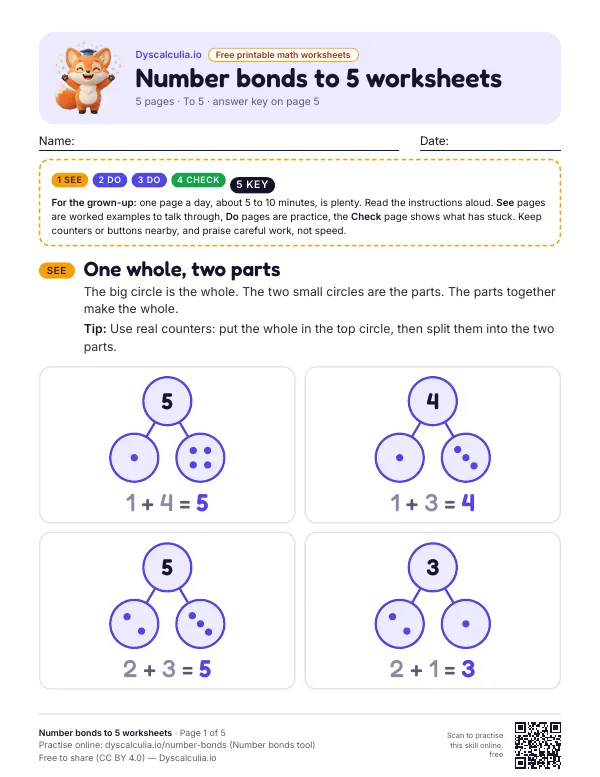
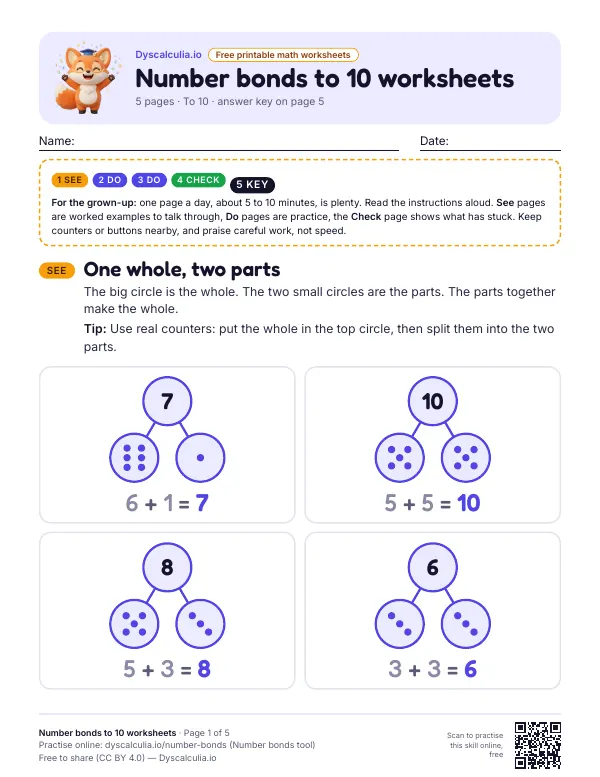
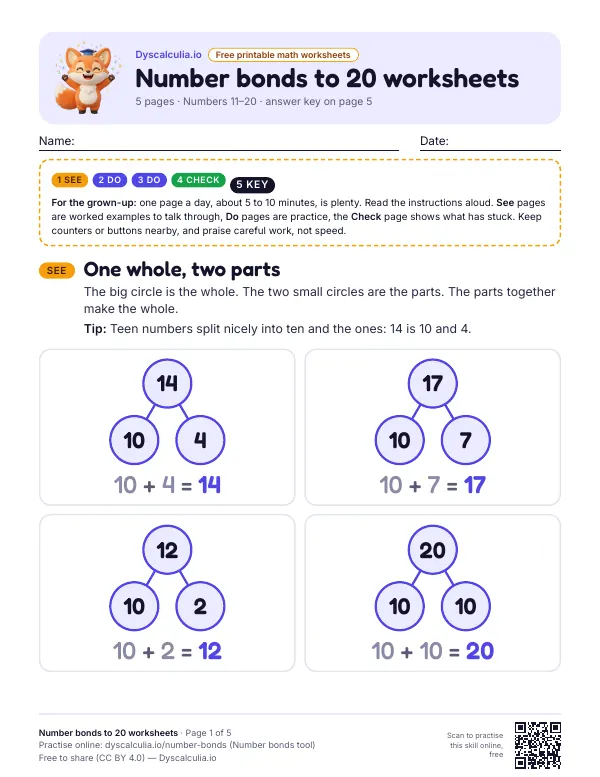
Number bonds are pairs of numbers that make a given whole, such as 3 and 7 for 10 or 9 and 11 for 20. They are usually drawn as a part-part-whole diagram: the whole in a top circle joined by lines to its two parts. Each bond gives a fact family of two additions and two subtractions (3 + 7 = 10, 7 + 3 = 10, 10 − 3 = 7, 10 − 7 = 3), and knowing bonds to 10 is what makes the making-ten strategy for adding within 20 work. Dyscalculia.io's free interactive number bonds tool splits any whole up to 20, lists every bond, quizzes the missing part and prints worksheets.
11
number bonds to 10, from 0 + 10 to 10 + 0; splitting numbers to 10 into pairs is a kindergarten standard1
4
facts from each bond: two additions, two subtractions; using that link is a grade 1 standard2
g = 0.76
average effect of number-fact fluency interventions for students with maths difficulties (35 studies)3
- A number bond has one whole and two parts: whole = part + part.
- 10 has 11 bonds counting 0 + 10, or 6 if turn-arounds count once.
- Every bond gives four facts: two additions and two subtractions.
- Bonds to 10 make adding within 20 easier: 8 + 6 = 8 + 2 + 4 = 14.
- Free, no sign-up; a new printable worksheet every time.
How to teach number bonds
Number bonds start with objects and end with quick recall. Move to the next step only when the current one is easy.
- 1
Split real objects
Give the child 10 counters and two plates. Ask for different ways to share them between the plates and say each one: 10 is 6 and 4.
- 2
Draw the bond
Draw the whole in the top circle and the two parts below, joined by lines. The interactive tool above draws it as you move the slider.
- 3
Find every bond in order
Go systematically from 0 and 10 to 10 and 0, so the child sees one part grow as the other shrinks and knows when the list is complete.
- 4
Write the fact family
Turn one bond into four facts: 6 + 4 = 10, 4 + 6 = 10, 10 − 6 = 4, 10 − 4 = 6.
- 5
Practise the missing part
Show the whole and one part and ask for the other. Aim for accuracy first, then speed, with the quiz or a printed worksheet.
Number bonds to 10: the full list
There are 11 number bonds to 10 if you include 0 and 10, and 6 different pairs if 3 + 7 and 7 + 3 count as the same bond. They are worth knowing by heart: US standards ask kindergarten children to split numbers up to 10 into pairs in more than one way and to find the number that makes 10 with any number from 1 to 9.1
| Bond | Addition facts | Subtraction facts |
|---|---|---|
| 10 = 0 and 10 | 0 + 10, 10 + 0 | 10 − 0 = 10, 10 − 10 = 0 |
| 10 = 1 and 9 | 1 + 9, 9 + 1 | 10 − 1 = 9, 10 − 9 = 1 |
| 10 = 2 and 8 | 2 + 8, 8 + 2 | 10 − 2 = 8, 10 − 8 = 2 |
| 10 = 3 and 7 | 3 + 7, 7 + 3 | 10 − 3 = 7, 10 − 7 = 3 |
| 10 = 4 and 6 | 4 + 6, 6 + 4 | 10 − 4 = 6, 10 − 6 = 4 |
| 10 = 5 and 5 | 5 + 5 | 10 − 5 = 5 |
Number bonds to 20 and the making-ten strategy
Bonds to 20 follow from bonds to 10: if 3 and 7 make 10, then 13 and 7 make 20, and 3 and 17 make 20. Choose 'Bonds to 20' in the tool to see all 21 of them.
The bigger payoff is adding and subtracting across 10. US first-grade standards name the strategies: making ten (8 + 6 = 8 + 2 + 4 = 10 + 4 = 14) and decomposing a number leading to a ten (13 − 4 = 13 − 3 − 1 = 10 − 1 = 9). Both need two bonds at once: 8 needs 2 to make 10, and 6 splits into 2 and 4. A child who has to count to find those bonds loses track of the sum.2
Number bond examples and fact families
The same diagram works for any whole and for missing-number questions. These are typical examples from first-grade worksheets.
| Whole | Parts | Fact family | Missing-part question |
|---|---|---|---|
| 7 | 4 and 3 | 4 + 3 = 7, 3 + 4 = 7, 7 − 4 = 3, 7 − 3 = 4 | 7 is 4 and ? |
| 9 | 6 and 3 | 6 + 3 = 9, 3 + 6 = 9, 9 − 6 = 3, 9 − 3 = 6 | 9 is ? and 3 |
| 12 | 10 and 2 | 10 + 2 = 12, 2 + 10 = 12, 12 − 10 = 2, 12 − 2 = 10 | 12 is 10 and ? |
| 15 | 8 and 7 | 8 + 7 = 15, 7 + 8 = 15, 15 − 8 = 7, 15 − 7 = 8 | 15 is 8 and ? |
| 20 | 13 and 7 | 13 + 7 = 20, 7 + 13 = 20, 20 − 13 = 7, 20 − 7 = 13 | 20 is ? and 7 |
Common number bond mistakes
Most errors come from learning bonds as a list of words rather than as amounts. Watch for these.
- Adding the whole and a part: for '10 is 3 and ?' answering 13. Go back to counters and show that the parts are inside the whole.
- Missing the zero bond: 0 and 10 is a real bond, and leaving it out makes the list look incomplete.
- Guessing a neighbour: answering 6 or 8 for 10 − 3. Check with the fact family: 3 + 7 = 10, so 10 − 3 = 7.
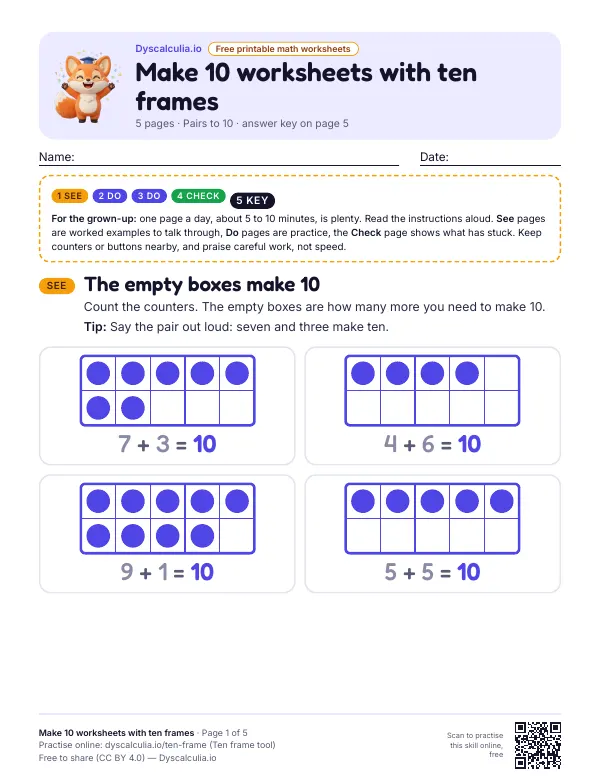
- Counting on fingers every time: fine at first, but if it never fades, return to the ten frame so the child can see the gap to 10.
- Practising speed before accuracy: timed drills on bonds the child does not yet know mostly practise guessing.
How number bonds help children who struggle with maths
Children with maths difficulties often find it hard to retrieve basic facts quickly, and without that retrieval new ideas in class are hard to follow. The What Works Clearinghouse practice guide for students who struggle with mathematics rates regular, brief timed activities to build fact fluency as supported by strong evidence, alongside concrete and semi-concrete representations, which a part-part-whole diagram is. A 2026 meta-analysis of 35 studies found an average effect of 0.76 for number-fact fluency interventions in students with maths difficulties, with wide differences between programmes.
Order matters: understand the bond with objects and diagrams first, then practise recall, then add time. The quiz in this tool is untimed on purpose. If bonds to 10 do not stick even after regular practice, and counting by ones carries on, it is worth looking at the underlying number skills: the free dyscalculia test screens five of them, and dyscalculia exercises explains how to practise them. The ten frame shows the same bonds as counters and gaps, and the place value chart takes tens and ones further.4,3