Rocket Line: a free number line game
A number is shown, and only the two ends of the line are labelled. Your child moves the fox's rocket to where the number belongs and lands it. A good landing plants a flag; a miss shows the right spot and the line's tick marks.
- Number line
- 5 levels
- Free · no sign-up
How to play Rocket Line
- 1
Read the number
The target number appears on a card. The line below shows only its two ends, such as 0 and 100.
- 2
Move and land
Drag the rocket, or tap a spot, then press Land. The arrow keys move it in small and big steps.
- 3
See how close you were
A landing within the target zone plants the flag and shows a bullseye meter. A miss sends a glowing guide to the right spot and shows the tick marks.
What Rocket Line practices: where numbers live
Placing a number on an empty line shows how a child pictures the size of numbers. Children with dyscalculia often squash big numbers together or space them unevenly, which later makes estimating, rounding and checking answers hard. Number line activities are among the most studied ways of practising number sense.
The five levels use lines from 0 to 10, 0 to 100, 0 to 1,000, 0 to 10,000 and 0 to 100,000. A landing counts as right when it is within 15% of the line's length from the true position, the same rule as the number line exercise in the Dyscalculia.io program.
While aiming, the rocket does not show the number it is over. That is on purpose: if it did, a child could slide until the numbers match instead of estimating. The landed value is shown afterwards.
Not sure which skill to start with? Take the free dyscalculia test — five short games, under 5 minutes, and a profile of five number skills.
All 5 levels of Rocket Line
Pick a level under the game. The levels are the same steps as in the Dyscalculia.io program, from easy to hard; each round makes 10 new questions.
| Level | What your child practices |
|---|---|
| 1 | Line from 0 to 10 |
| 2 | Line from 0 to 100 |
| 3 | Line from 0 to 1,000 |
| 4 | Line from 0 to 10,000 |
| 5 | Line from 0 to 100,000 |
Common mistakes in Rocket Line and what they tell you
Squashing big numbers together
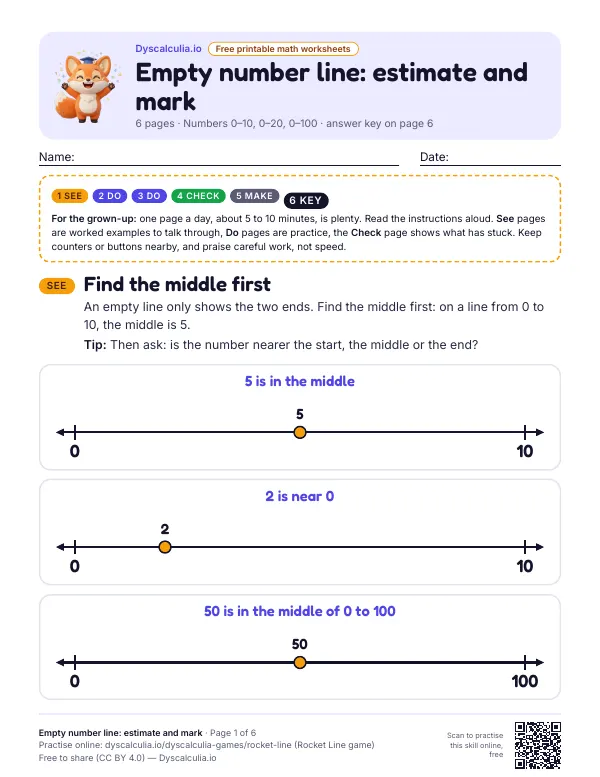
Placing 70 close to 100 and 20 close to 50 on a 0–100 line is a common pattern: the child spaces numbers by feel rather than evenly. Finding the middle first helps.
Placing numbers by their digits
Putting 300 near the start of a 0–10,000 line is right, but putting 3,000 there too means the size of the number has not been taken into account.
Always landing in the middle
A child who lands everything near the middle is guessing. Go back a level and talk through where the halfway point is.
Tips for parents: getting the most out of Rocket Line
- Before landing, ask “is it nearer the start, the middle or the end?” Finding the middle first is a strong strategy.
- After a miss, look at the tick marks together and count along them to the right spot.
- Draw a 0 to 10 line on paper and place numbers with a pencil; then try 0 to 100.
- Move up a level when most landings hit the target, and go back if the rocket lands far away more than three times.
Printable number line worksheets
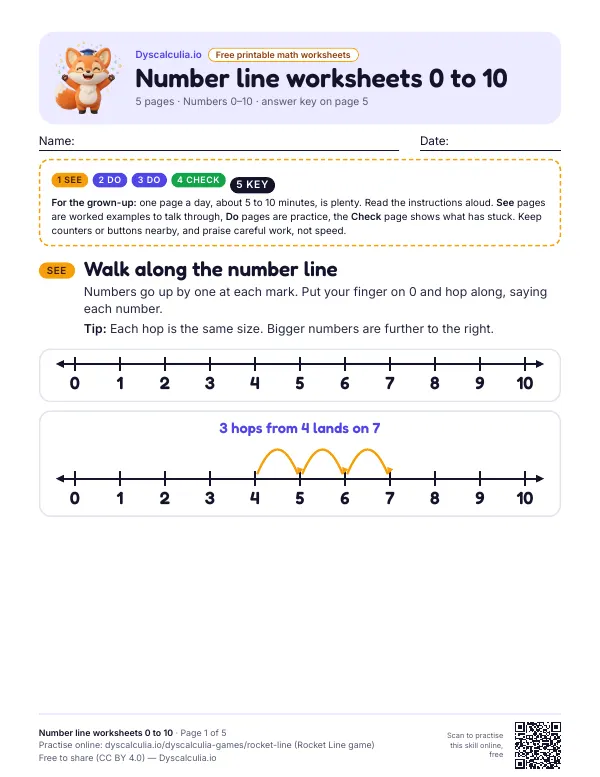
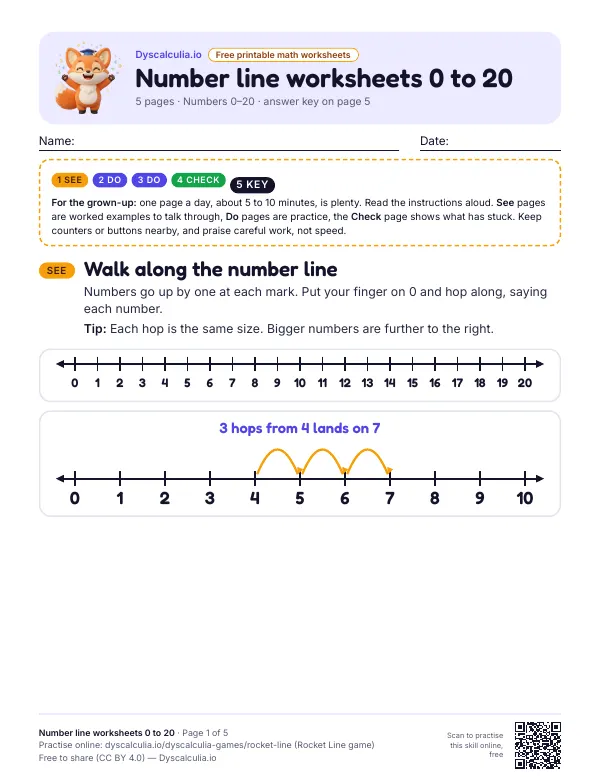
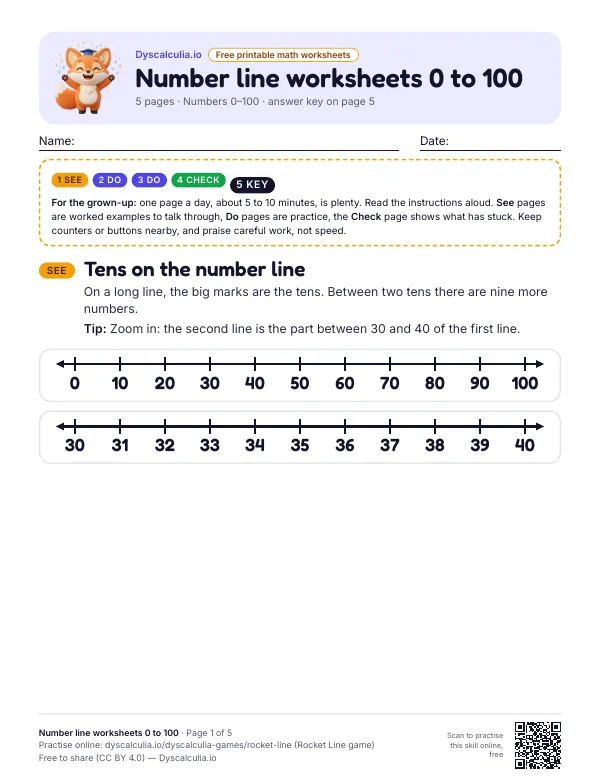
Take Rocket Line off the screen: the same skill as free PDF worksheets, from dots and pictures to numbers, with an answer key on the last page.
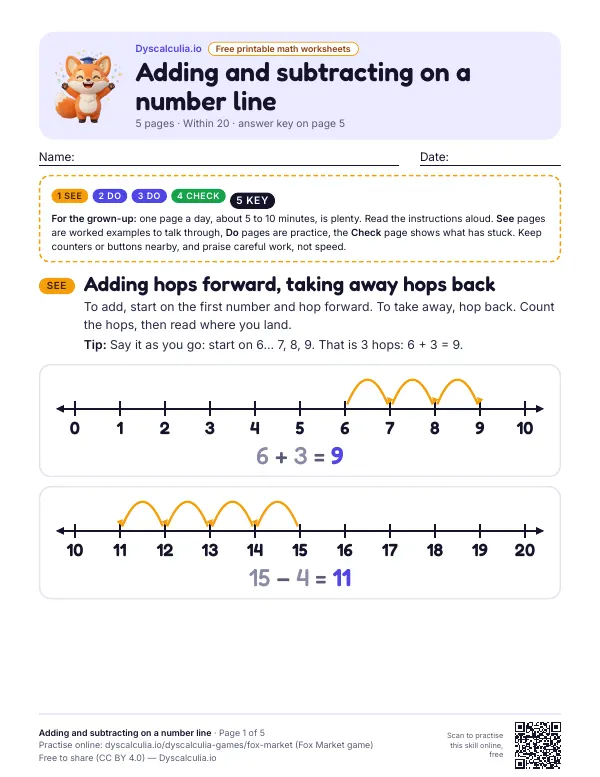
All 26 free dyscalculia worksheets → · Free to share (CC BY 4.0) — Dyscalculia.io
More free dyscalculia games
Rocket Line: questions parents ask
Is Rocket Line free?
Yes. Rocket Line is free to play in the browser, with no account, no download and no ads. The paid part is the Dyscalculia.io program, which adds a daily plan, spaced review and saved progress.
How close does the rocket have to land?
Within 15% of the length of the line from the right spot, so within 1.5 on a 0 to 10 line or within 15 on a 0 to 100 line. That is the same rule as in our program's number line exercise.
Does Rocket Line work on a tablet or phone?
Yes. It runs in any modern browser and works with a finger, a mouse or the keyboard. On a phone, turn it sideways for the biggest picture.
What age is Rocket Line for?
The 0 to 10 and 0 to 100 lines suit children from about 6. The 0 to 1,000 and larger lines suit older primary children, teenagers and adults.
Why are only the two ends of the line labelled?
Because the game practises estimating where a number belongs, not reading tick marks. With only 0 and the end shown, the child has to think about the size of the number. After every answer the tick marks appear, so the child can check.