Lantern Memory: a free number memory game
Paper lanterns float up into the night sky one at a time, each showing a digit. Then your child lights the fox's lantern string in the same order. Every correct string rises to join a glowing trail across the sky.
- Number memory
- 5 levels
- Free · no sign-up
How to play Lantern Memory
- 1
Watch the lanterns
Lanterns rise one by one, each with a digit for 1.2 seconds. Only one digit is visible at a time.
- 2
Light them in order
Tap the lantern keys in the same order, or type the digits. Use the back key to fix a mistyped digit before you confirm.
- 3
Check the string
Right: the lanterns light up and float into the sky. Wrong: the right sequence appears under your answer, with the different digits marked.
What Lantern Memory practices: holding numbers in mind
Working memory is the mental notepad that holds a phone number, the steps of a sum or the number you carried. Many children with dyscalculia have a shorter span for numbers, which makes multi-step maths fall apart even when they understand each step.
The five levels ask the child to remember 3, 4, 5, 6 and 7 digits, always in the order they were shown. Each digit is visible for 1.2 seconds. The rules are the same as the number memory exercise in the Dyscalculia.io program, which also measures this skill in the free dyscalculia test.
We do not claim that memory games improve maths by themselves; the research on that is mixed. Lantern Memory is useful as practice of the skill itself and as a way to see how much a child can hold in mind.
Not sure which skill to start with? Take the free dyscalculia test — five short games, under 5 minutes, and a profile of five number skills.
All 5 levels of Lantern Memory
Pick a level under the game. The levels are the same steps as in the Dyscalculia.io program, from easy to hard; each round makes 10 new questions.
| Level | What your child practices |
|---|---|
| 1 | Remember 3 digits in order |
| 2 | Remember 4 digits in order |
| 3 | Remember 5 digits in order |
| 4 | Remember 6 digits in order |
| 5 | Remember 7 digits in order |
Common mistakes in Lantern Memory and what they tell you
Right digits, wrong order
Remembering the digits but swapping two of them is the most common error. Saying the digits quietly while they appear helps keep the order.
The first digits are lost
Forgetting the start of a long string means the span is full. Stay on the level and practise chunking digits into pairs.
Fine at 3 digits, lost at 5
A sudden drop between levels is normal: each level adds a digit. Move up only when most strings at the current level are right.
Tips for parents: getting the most out of Lantern Memory
- Teach chunking: 4 7 2 9 is easier to hold as 47 and 29.
- Ask your child to say the digits quietly while the lanterns rise. Saying them helps keep them in mind.
- Stay on a level until most strings are right, then add one more digit by moving up a level.
- Keep sessions short: memory practice is tiring, and one or two rounds a day is plenty.
Printable number cards 0 to 20
Take Lantern Memory off the screen: the same skill as free PDF worksheets, from dots and pictures to numbers, with an answer key on the last page.
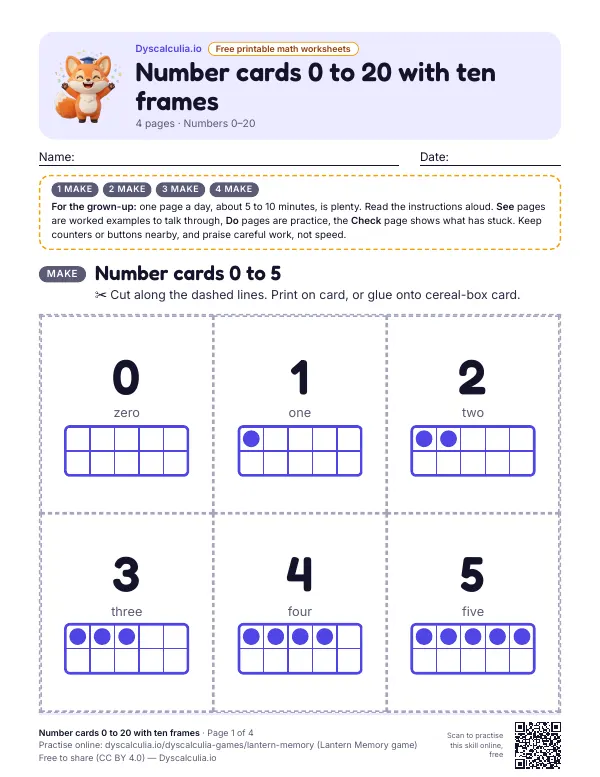
All 26 free dyscalculia worksheets → · Free to share (CC BY 4.0) — Dyscalculia.io
More free dyscalculia games
Lantern Memory: questions parents ask
Is Lantern Memory free?
Yes. Lantern Memory is free to play in the browser, with no account, no download and no ads. The paid part is the Dyscalculia.io program, which adds a daily plan, spaced review and saved progress.
Will this game improve my child's maths?
It practises remembering numbers, which maths depends on, but research on whether memory training improves maths by itself is mixed. Use it alongside the number games that practise maths skills directly.
Does Lantern Memory work on a tablet or phone?
Yes. It runs in any modern browser and works with a finger, a mouse or the keyboard. On a phone, turn it sideways for the biggest picture.
How many digits can a child usually remember?
It depends on age. Many young children hold 3 or 4 digits and most adults about 5 to 7. The game starts at 3 digits and goes up to 7.
Why are the digits always remembered in the same order?
The game follows the forward digit span task used in our program and in our free test: the digits are recalled in the order they appeared. Recalling them backwards is a harder, different task that the program does not use.