
Short answer
What is skip counting?
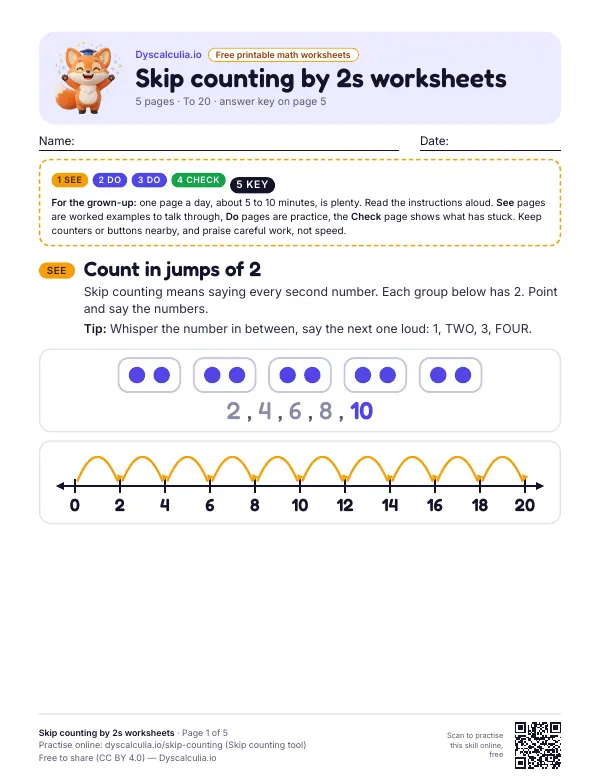
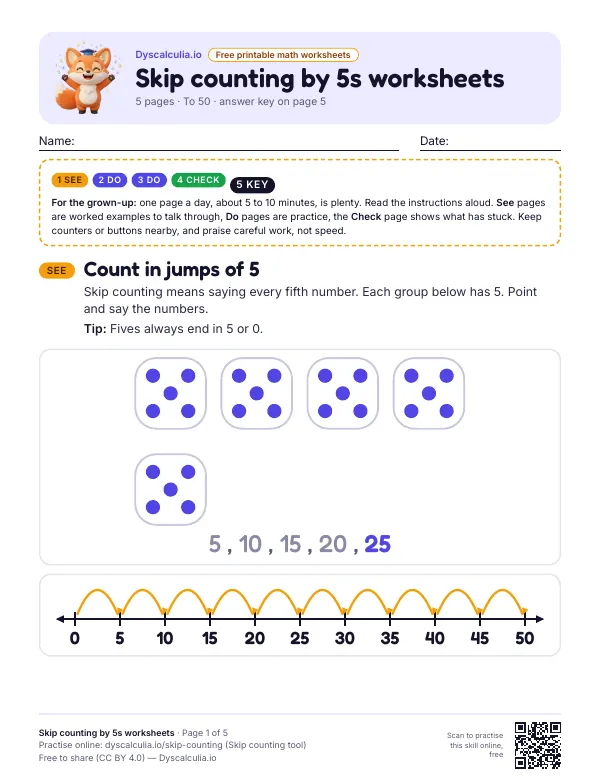
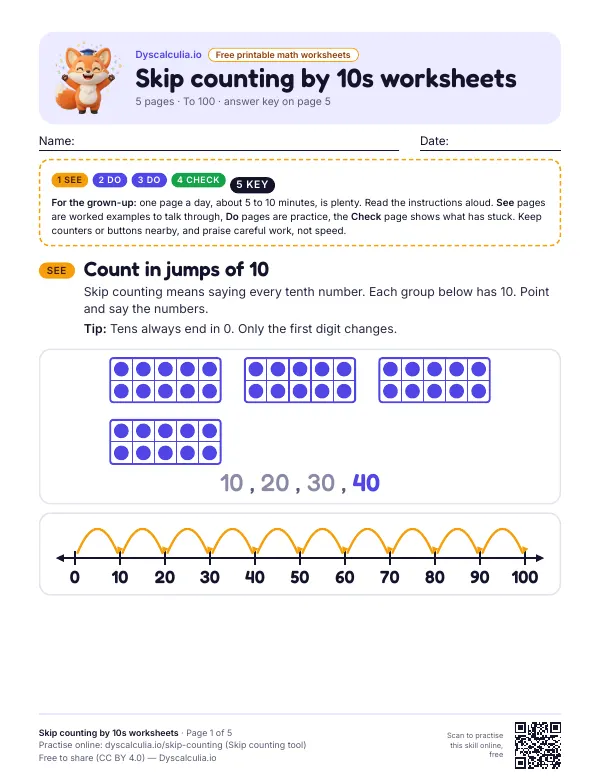
Skip counting is counting by a number other than one, forward or backward, by adding or taking away the same amount each time: by 2s (2, 4, 6, 8), by 5s (5, 10, 15, 20) or by 10s (10, 20, 30). In the US Common Core standards, kindergarteners count to 100 by tens and second graders skip-count by 5s, 10s and 100s within 1,000. Skip counting builds number patterns and leads directly into multiplication: counting three jumps of 5 gives 15, the same as 3 × 5. Dyscalculia.io's free skip counting chart shows each step on a hundred chart and a number line, with gap-filling practice.
- Skip counting adds or subtracts the same number each time.
- Common Core: count to 100 by tens in kindergarten (K.CC.A.1).
- Common Core: skip-count by 5s, 10s and 100s in grade 2 (2.NBT.A.2).
- Counting n jumps of a step is the same as n × step.
- Skip counting works backward too: 20, 18, 16…
How to teach skip counting
Go from things you can see and touch to the pattern on a chart, then to saying the sequence from memory.
- 1
Count real groups
Put socks in pairs, coins in fives or blocks in towers of ten, and count the groups: 2, 4, 6. Each number names a whole group.
- 2
See the pattern
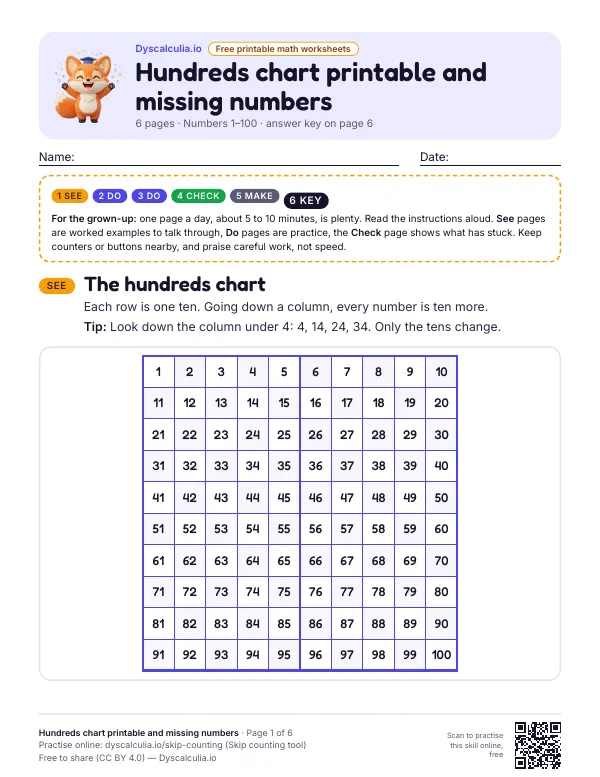
Choose a step in the chart above and press Play the jumps. Talk about what repeats: 5s always end in 5 or 0, 10s in 0.
- 3
Jump on the number line
Switch to the number line. Each arc is one jump of the same size, which is what turns skip counting into multiplication later.
- 4
Count backward too
Pick Backward and count down from the top: 50, 45, 40. Counting back prepares subtraction and division.
- 5
Fill the gaps
Use the Fill the gaps rows. Leave the first two numbers visible so the child can work out the rule before filling in.
- 6
Print and practise away from the screen
Print the chart for one step and stick it up. Say the sequence while climbing stairs, clapping or bouncing a ball.
Skip counting chart: 2s to 10s, 25s, 50s and 100s
The chart lists the first ten numbers for each step. Read across a row to skip count; read the tenth column to see that ten jumps of any step land on ten times that step. The interactive chart above shows the same rows on a hundred chart and a number line, and both can be printed.
| Count by | Sequence |
|---|---|
| 2s | 2, 4, 6, 8, 10, 12, 14, 16, 18, 20 |
| 3s | 3, 6, 9, 12, 15, 18, 21, 24, 27, 30 |
| 4s | 4, 8, 12, 16, 20, 24, 28, 32, 36, 40 |
| 5s | 5, 10, 15, 20, 25, 30, 35, 40, 45, 50 |
| 6s | 6, 12, 18, 24, 30, 36, 42, 48, 54, 60 |
| 7s | 7, 14, 21, 28, 35, 42, 49, 56, 63, 70 |
| 8s | 8, 16, 24, 32, 40, 48, 56, 64, 72, 80 |
| 9s | 9, 18, 27, 36, 45, 54, 63, 72, 81, 90 |
| 10s | 10, 20, 30, 40, 50, 60, 70, 80, 90, 100 |
| 25s | 25, 50, 75, 100, 125, 150, 175, 200, 225, 250 |
| 50s | 50, 100, 150, 200, 250, 300, 350, 400, 450, 500 |
| 100s | 100, 200, 300, 400, 500, 600, 700, 800, 900, 1,000 |
Skip counting patterns to look for
Children remember skip counting sequences much more easily when they notice the patterns inside them rather than memorising a list. The hundred chart makes most of these visible at once.
- By 2s: every other number; all even; the ones digit goes 2, 4, 6, 8, 0.
- By 5s: always ends in 5 or 0, alternating.
- By 10s: always ends in 0; the tens digit goes up by one each time — the pattern a place value chart makes visible.
- By 4s: every second number when counting by 2s.
- By 9s: the tens digit goes up by one while the ones digit goes down by one (9, 18, 27, 36).
- By 3s: on a hundred chart the numbers form diagonal lines.
- By 25s: 25, 50, 75, 100 — four quarters make a whole, like coins.
Skip counting and multiplication
Skip counting is the bridge between counting and multiplication. Counting four jumps of 3 — 3, 6, 9, 12 — gives 12, which is 4 × 3. On the number line above, each arc is one group of the same size; the number of arcs is the number of groups. A child who can skip count by 3s can work out any 3 times table fact even before it is memorised.
Backward skip counting does the same for division: counting back from 12 by 3s reaches 0 in four jumps, so 12 ÷ 3 = 4.
When children learn skip counting, grade by grade
In the US Common Core State Standards, kindergarteners count to 100 by ones and by tens, and second graders skip-count by 5s, 10s and 100s within 1,000. Skip counting by 2s, 3s and 4s usually comes in first and second grade, and by 6s to 9s alongside times tables in third grade. Other curricula follow a similar order.1,2
Skip counting games and activities
Skip counting sticks best when it is said aloud, moved to and connected to real groups. A few minutes a day beats a long session once a week.
- Clap and count: clap on every number but whisper the in-between ones, so only the skip-counted numbers are loud.
- Stair jumps: say the next number by 2s or 5s on each step.
- Coin counting: count nickels by 5s, dimes by 10s and quarters by 25s.
- Hundred chart colouring: colour every 3rd number and look at the shape it makes.
- Missing number: say a sequence with one number left out and ask which one is missing.
- Ball toss: pass a ball and say the next number in the sequence as you catch it.
When skip counting stays hard
Some children can recite "5, 10, 15, 20" but do not connect it to groups of five, and others lose track after a few numbers. Go back to real objects in groups, use the number line so the jumps are visible, and practise one step at a time — usually 10s, then 5s, then 2s.
If counting and number patterns stay unusually hard despite regular practice, it can be worth checking other number skills too. The free dyscalculia test takes under five minutes; it is a screening, not a diagnosis. For everyday ideas, see how to help a child with dyscalculia and subitizing practice.